Twin Pond Dyes.. Beautiful Vermont
August 1, 2012
 A trip to Vermont last this week brought a wave of inspiration for natural dye color. I taught a two-day class for a group of 17 who came from a range of places from across the United States. The workshop was hosted by Twin Pond Retreat, and paid for by a grant by the Vermont Women’s Farm Foundation. We spent the first day preparing our wool, organic cotton and other samples in sumac leaves, alum, rust water, bog mud, and cow’s whey.
 The sumac leaves were cooked lightly for just one half hour before entering the raw materials into the pot. The tannin in the sumac was rich at this time of year.
 Apple branches were pruned, (these came from a wild apple tree), we harvested lady bedstraw, goldenrod, madder, fresh indigo, black walnuts, purple basil, coreopsis, sumac berries, and I also brought sage from California to share with the group. Other than the sage, everything had come from the garden.

The mordanting and preparation all took place on the first day… we prepped 7 dye vats in total. It was an ambitious and exciting task to combine those colors with so many mordant options. It would have likely taken a week to even begin to explore the color permutations.
 That night we ate wood-fire pizzas as the dyes cured and the mordanted fibers dried. We ate and dyed from the same garden. Re-inforcing the food, fiber, and dye connection. It is true that what we eat, and what we wear are crucial pieces of the human ‘well-being’ puzzle, and the way we procure these necessities either hinders or enhances the existence of other species and our own progeny.

Madder root was harvested fresh from the garden (3yr. old roots), and we created a beautiful frothy red vat.

The samples of red are pulled out of the vat, almost ready, the red takes time, the heat must be slow and low.

The cool spectrum colors were abundant (which is rare), but we had tannin and iron reactions, purple basil, and fresh indigo to do the trick.

Some of the samples are lined up here, including a pH modified coreopsis strip, made yellow with vinegar and deep orange with wood ash.

The rug wool samples were divided up amongst the group.. light pink from bedstraw, red from madder, sky blue from fresh indigo, tan from sumac, gold from apple bark, and turquoise from purple basil, orange from coreopsis.
 The pond was just a short walk from our dye station, and very swimmable. The edge of the body of water housed an iron rich bog– which we also put to good use.
 The bog was filled with conifer needles, and over time the decomposition had created an iron-rich concoction.
 The cloth was originally rolled up tightly– here you can see it after it had been unrolled, it turned black all along the edges where it was exposed to the bog (in just one full day of soaking). The inside of the cloth had been rolled up with maple leaves that had just begun to leave a tannin reaction that could be seen as a light green outline of the leaves in the center of the fabric… (given more time the leaf imprints would have been black.)
 At the end of the last day the sun began to set and the samples were collected in the last remaining light. Our group was hard-working and compiled a lovely collection of garden colors.
 Our wool yarns illuminate the rainbow that came from the Twin Pond Garden. A beautiful array of botanic color.

Thank you Jennifer Steckler and Twin Pond for your incredible Vermont hospitality– and for nurturing such a special place on this planet.. and thank you Sierra Reading for your incredible work and teaching skills! What an outstanding and deeply inspired event!
Farm Alley
July 21, 2012

Farm Alley in Lagunitas hosted a beautiful week of ‘from the ground-up’ textile education, with special surprise visits from some of our local Fibershed talent! We all loved the cashmere goats, who romped around with the children all week and received so many formal names its hard to say what the children decided on. I think this little one ended up as ‘Carmel’. The goats came from Mary Pettis-Sarley’s ranch for our week of fiber education.

We also had a visit from ‘Peter’ the very relaxed and easy going angora rabbit, who was given a ride to camp by his farmer, Allison Arnold. Peter relaxed in the shade of the oak grove and enjoyed a stream of loving caresses and hair brushing.
 Allison had the children give Peter a haircut and then she showed them how to spin his fiber into yarn.

Katherine Jolda came to our textile camp too and showed the children how to ride her bicycle powered drum carder. After creating a beautiful combed batt of wool from locally raised sheep the children learned to felt the fiber into small patches.

We harvested dye plants from our meandering wall of coreopsis that runs through an acre of meadow, like a curving water-way.

The children harvested enough to dye their sample fabrics and shirts.

They made bean bags with designer Amber Steinhauer from elder, black walnut, fennel and coreopsis dyed fabrics…

We created an impromptu form of ‘cornhole’ although we didn’t exactly have it set up in the traditional sense, everyone loved keeping score and tossing their homemade bean bags.

We kept the dye vats running over several days for the children to create and explore with. Each color was generated by the children’s own work to process the plants.

Everyone enjoyed squishing elderberries between their fingers.. hammering the fallen walnut shells, and chopping up the long fennel stalks.

Each child’s afternoon activity was steeped with free time to weave on looms, paint with beets, tumeric, and clay, climb trees, and build relationships with the animals.

Kid goats and kid humans make great companions.

Our final day was spent making paper from old jeans and T-shirts with paper maker Michelle Wilson.. (the final chapter of our textile story). “From the ground up textiles” have many lives. The children were excited to see an alternative to making paper from trees.

California School of Herbal Studies & Botanic Color
October 12, 2011
 The first early rains came just before our annual dye class at the California School of Herbal Studies. The first year roots students were, as usual, wonderful to work with. The collective connectivity, appreciation, and understanding that the students have for the earth and its processes is phenomenal.
 The dry line is a testament to the richness of autumn color. Late season fennel, pokeberry, toyon, black walnut, and oak galls adorn the outside of the medicine making kitchen. Students brought things from home as well as explored a myriad of cellulose and protein fiber samples.

The students had made felt pouches in an earlier class, and brought them to our dye workshop to see if they could color them in our vats. This experiment was with pokeberry.

This was a very fun collection of samples– with multiple over dye processes taking place.

Oak galls, coreopsis, pokeberry, local wool and some (non-local) silk look incredible in the late day sun.

Black walnut, toyon, and coreopsis samples in hand after a good days work.

Fuzzy fennel and iron dyed felt pocket, and a happy owner.
Thank you roots students… awesome day!
Late Summer into Fall…
September 25, 2011
 Beginning with a late summer workshop at the Regenerative Design Institute in Bolinas, California, we played with freshly harvested sage, coreopsis (bright orange), and an early harvest of toyon and coffeeberry… with a bit of sheep sorrel in the mix.
 The class was focused on experimenting with seawater as a mordant. We harvested from the ocean early in the morning and compared our results between the salty sea pre-treatments with the effects of alum and iron. The seawater held its own.. the brightness of the dye vats was not diluted by the use of the ocean minerals. One of the Fibershed designers– Ashley Brock (left) is seen with her indigo and cutch dyed tunic, and wool pendant.
 Erin Reilly of the Regenerative Design Institute with Dustin Kahn (Fibershed’s marketplace creator), rinse samples in the newly renovated greenhouse. The new space is so warm and perfectly lit for dye workshops, with a perfect amount of burners for all the dye vats!

Local wool yarns from Tennessee Valley in Southern Marin were dipped in the various dye pots as well as modified with wood ash from the wood burning stove. This wonderful participant will be going back to her Waldorf school with new recipes for the children to try–(such a joy to teach other teachers, knowing the plant recipes will travel through the generations and other institutions).
 A botanic experiment in the works with a father and daughter duo.

It was off to Pennsylvania not long after enjoying the coastal beauty of Northern California. Amish country awaited. Rolling cultivated hills, covered in green, dappled with goldenrod, poke and elderberry, a wonder for any dye loving human being.

The Western Pennsylvania landscape is beautifully maintained by the Amish, a fully remarkable society of people who have made a very strong commitment to a set of values that harken to pre-industrial past.

The workshop took place at the Nature Center at Westminster College. Professors from various disciplines have come together in the name of a new and powerful environmental studies program, I came to teach and support their endeavor– by bringing the sciences and the arts together via natural dye making. The dinner conversations wove through subjects of Robert Hass, banning poly bisphenol, protecting fresh water resources, and the joys of living in such a grounded small American town.

Pokeberry bliss…. the color is so beautiful, the plant so generous.. we dubbed it, our ‘North American cochineal.’
 A black-eyed susan sits above a coreopsis dyed cotton with stripes of printed homemade alum acetate. Students loved using their magnetic stirrers and following simple ‘green’ chemistry instructions to create their own bonding agents.

Fingers and hands stained…..

The subtle effects of an acetate and leaf print on a coreopsis cotton dipped in a pH modifier of ash and water.

Thank you Westminster, Peggy Cox, and all the organizers, students, and participants who created such an incredible foundation for a wonderful series of classes and talks. I am forever changed having been exposed to this peaceful place.
Farm Alley
August 5, 2011
 Farm Alley classes brought the artisan production of food, clothing, and shelter to many children this summer. During three, one-week sessions, we kept extremely busy with many homegrown activities, harvesting wild foods, sewing clothes, climbing in the orchard, constructing shelters, and creating our own garden variety dyes.

A well made and dyed shirt, accompanied by a lot of wool… ready for the knitting needles!

The work cart became a vehicle…. moving with slope and gravity, the activity became a favorite.

The indigo and distaff apron went home a little damp, but it was to hard to resist wearing it out the door…

During our last and final week of food focused activity, we made plum-honey-blackberry soda with wild yeast, and toured local food farms and gardens that line the country road we call…. Farm Alley.

Here is our wholewheat short-bread covered in blackberry, stevia and tumeric dyed icing– adorned with sprinkles of fennel seed, dried orange, violets, hibiscus and rose petals…

The cotton fabric we used to squeeze and strain our naturally fermented soda held a temporary and beautiful shade of orange and pink.

The plum and blackberry soda was presented at the children’s farm stand on our last day of our last week of classes–sitting atop an onion and plum leaf dyed cotton swath of cotton.

We also made fruit leather from apples, figs, and blackberries. The children explored how to remove water from our wet mash– we tried three experiments– the sun, the oven and dehydrator.
The sun won… the most direct, and least impacting form of energy dried our fruit leather faster than the oven or the dehydrator.
 Our rust experiments carried over through two weeks of class. The sun cooked the iron objects in our water bath– providing a rich and smelly dye and mordant– all in one. We overdyed the cloth in our plum and onion water creating a range of earthy tones.

The farm stand– housing all of the week’s food adventures. Sun tea made from lemon verbena was served with sun-dried fruit leather, naturally fermented soda, blackberry preserves, naturally leavened bread, flowers from Mt. Barnaby Farm (where we visited earlier in the week), and whole wheat naturally adorned short bread.

The weeks passed by quickly and were an inspiration to us all– one of the young participants made a book inspired by her good times.

Thank you also to Kaiku, Mr. Peabody, Figellius, and Princess I-ching (the very sweet and lovely resident goats and lambs) who played with the children every day. They seemed to have as much energy as the young humans– running jumping, chasing, snacking… they were excellent playmates for us all.
Colors of California
July 10, 2011

Toyon, Oak Galls, Japanese Indigo, Fennel, Coyote Brush, Distaff…. this just-finished set of samples was so vibrant and joy producing, I had to share…. the preparation took several days of harvest, dye vat creation and skein winding!

The Sally Fox Cotton Yarns and Mary Pettis-Sarley’s wools illuminate the regions colors and fibers. Indigo blue is so striking this time of year…

Those blues have inspired a lot of indigo growing, my crop is doing well. All seeded and planted by hand. Hand weeded, hand fertilized with cow and duck rich manures, and hand-sprayed with compost tea. This agricultural source of blue is an addition to the native palate, and so well worth all the work of my hands!

This latest sample book illuminates the beauty of a ‘weed’ like fennel (soft yellow), and how lovely it combines with the indigo– providing an array of turquoise that moves into a range of deeper blues which were created with indigo all by itself.
Enjoy!!
Off to the farm for an evening weeding session
Wheat & Walnut Groves
June 29, 2011
 The summer has begun, the solstice has just now past. The sunlight dwells until well past 8 o’clock. My late night runs to the indigo field after long days of teaching have been well lit by setting rays of light. This week’s classes are just down the road from the farm in a 40 year mature walnut grove. This picture was drawn with beeswax crayons by one of our campers. The wheat berries were found growing wild in an old pasture, we husked and peeled the plump golden seeds.

The life size jute weaving wall is being slowly constructed under the ancient walnut tree. Willow and plum sticks make for flexible weavers.
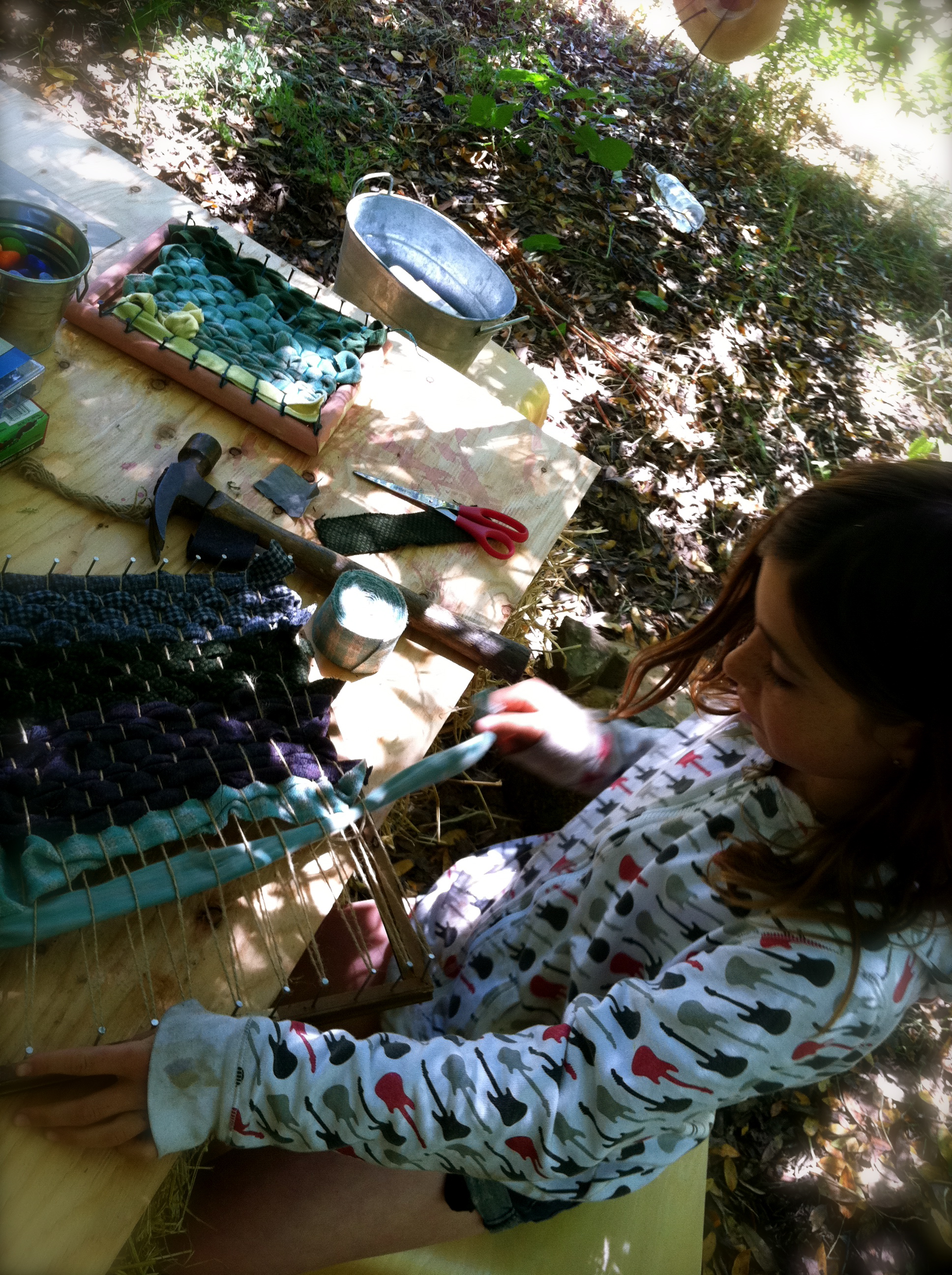
This simply constructed loom was made with old picture frames… the children wove strips of vintage wool from mid-century patterned suit cloth.
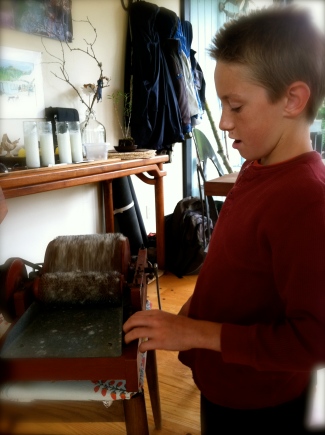
The 100 yr. old drum carder fascinated and provided such a meditative movement to the children’s morning routine. They carded with hand-tools and then moved to the crank machine. “So much faster… this machine!” they all commented.
 Gathered rocks are harvested for making patterns in our clothes. These were collected at the edge of the bay during our one week museum classes.
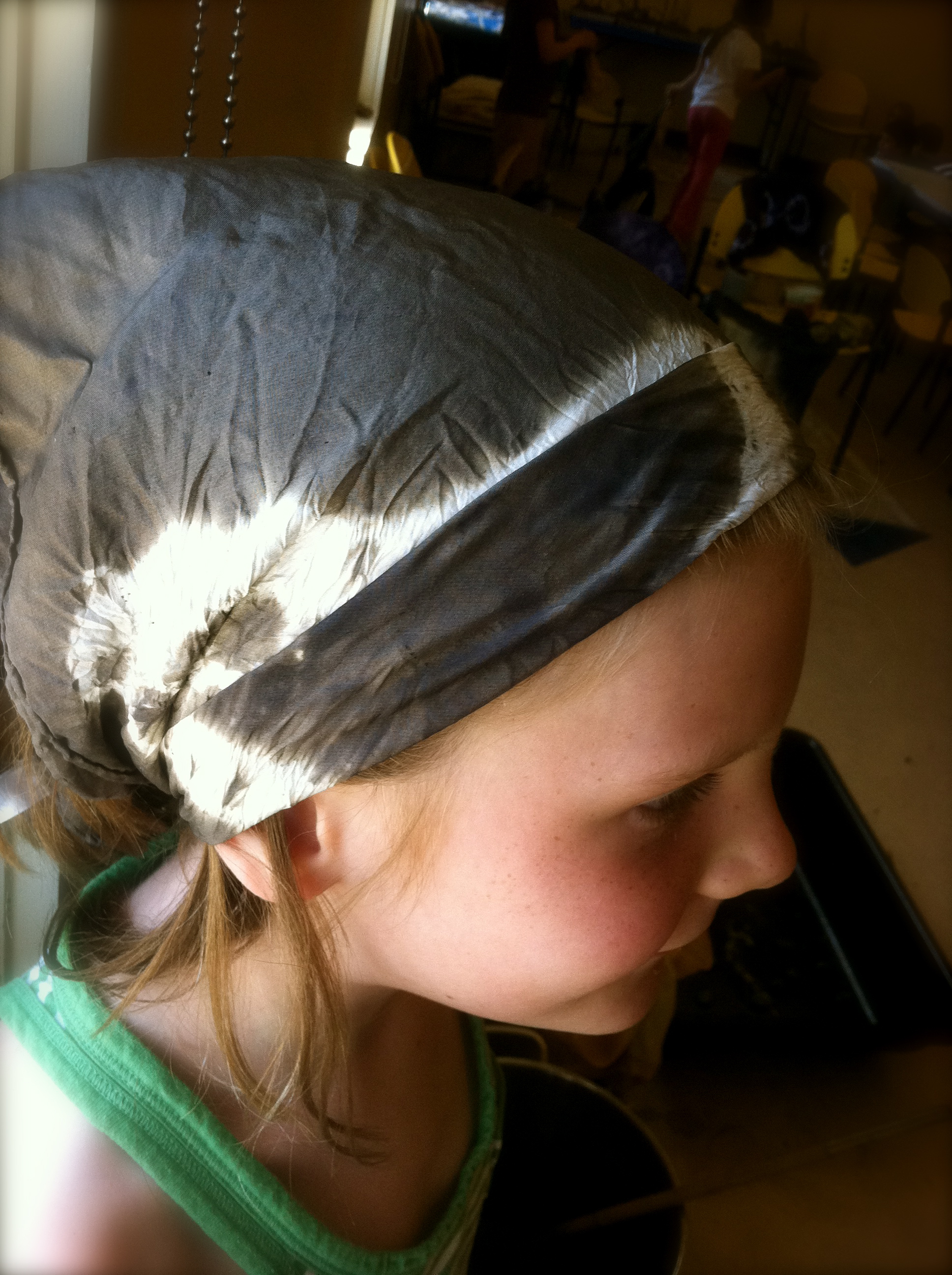
The effects of the children’s oak and iron experiments mixed in with some adept rock tying processes created this beautiful head scarf.
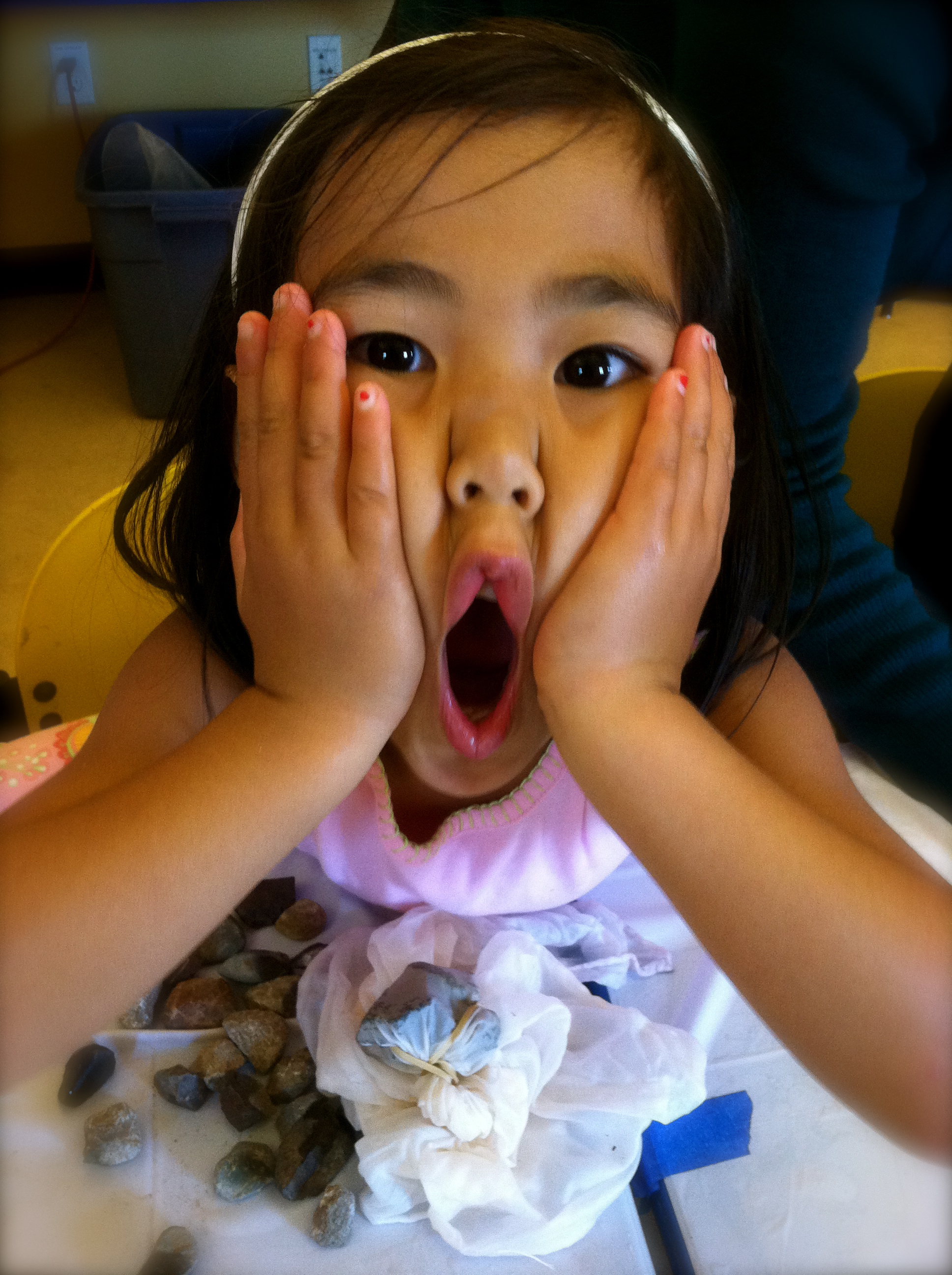
The excitement of making “ghost heads” in our T-shirts became overwhelmingly odd and funny.
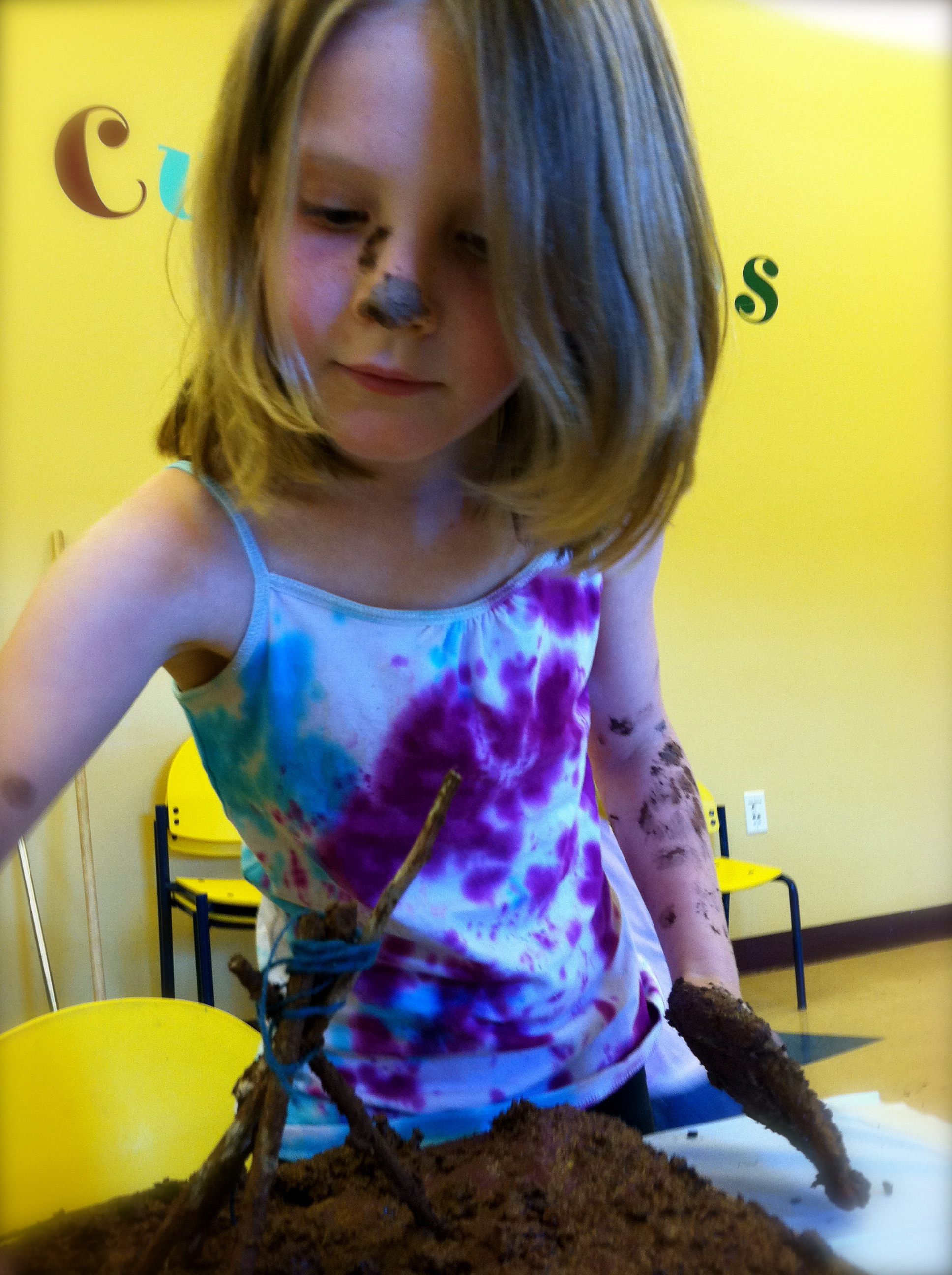
The adobe houses were made with free form abandon– sticks and seaweed adorned the mud structures. Discussions of renewable resources, and ‘using what is abundant for it’s first and best use’ was the theme of our house planning process.
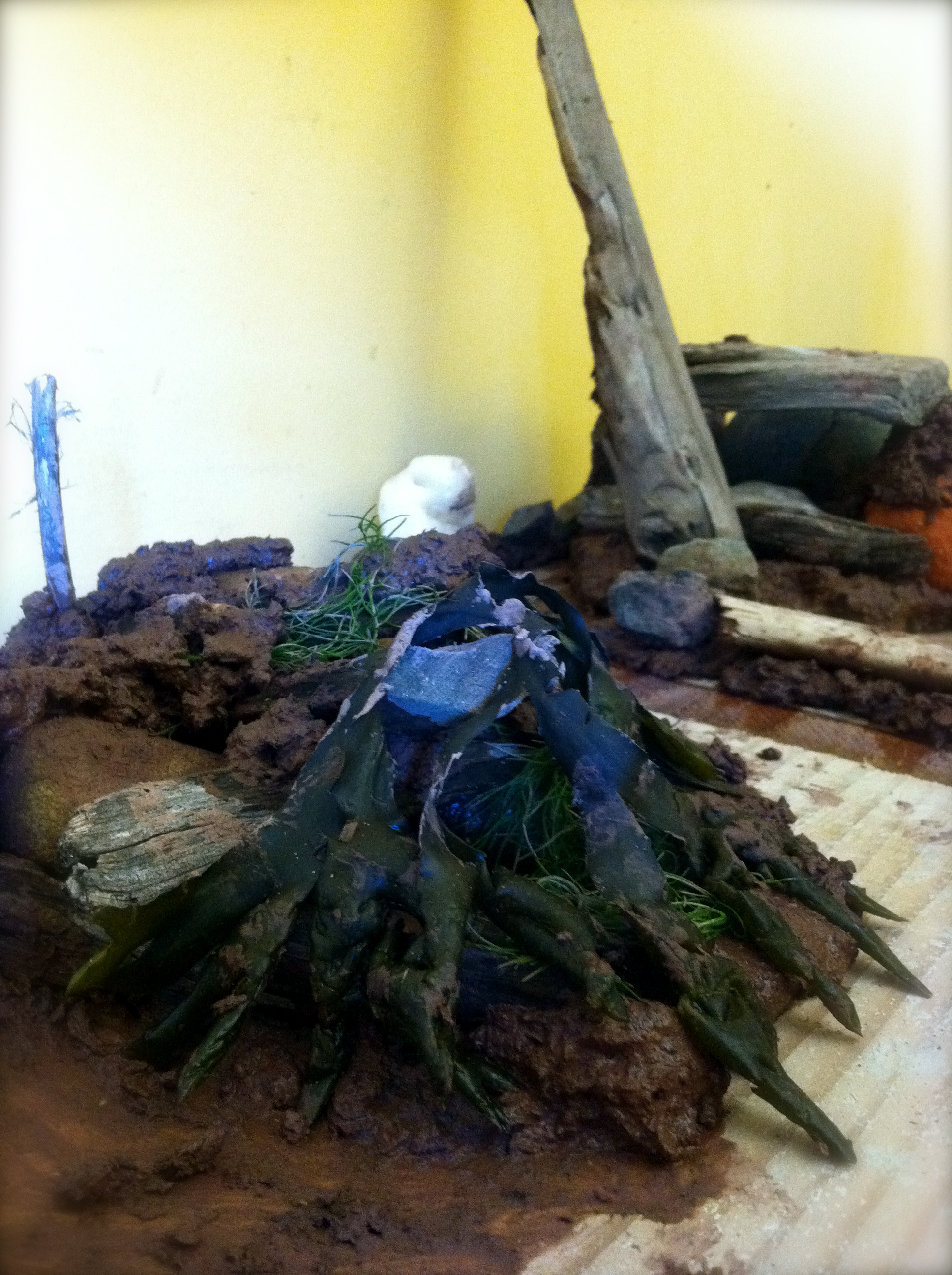
Every material found a use. All found objects were woven into the architecture of the home. The ocean plant life dried quickly leaving a firm and useful roof for this little house.
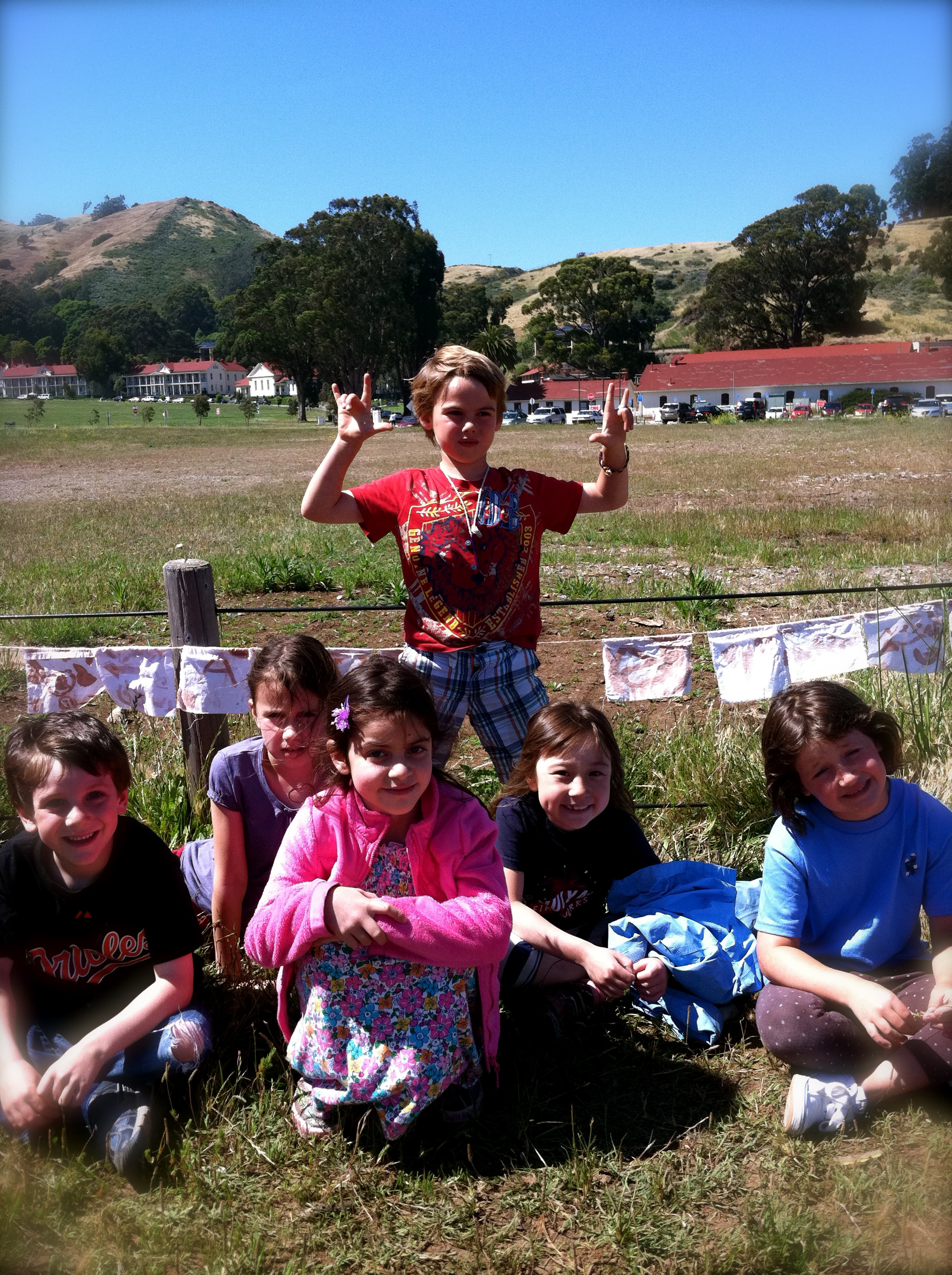
Our last and vital activity was to create clay dyed protection flags to bring awareness to the ground nesting Killdear birds. We could not imagine how the little birds could have remained safe amid the hustle and bustle of the museum grounds– we did what we could to let the passer-bys know of their existence.
More summer images and impressions from the children’s eco-art processes to come….
The Days of Spring Dyeing
May 29, 2011

The spring dye season began at the Filoli Estate in Woodside this year. Expansive meadows, riparian ecosystems, oak studded woodlands… a perfect place for our first and semi-rainy day of dye work.
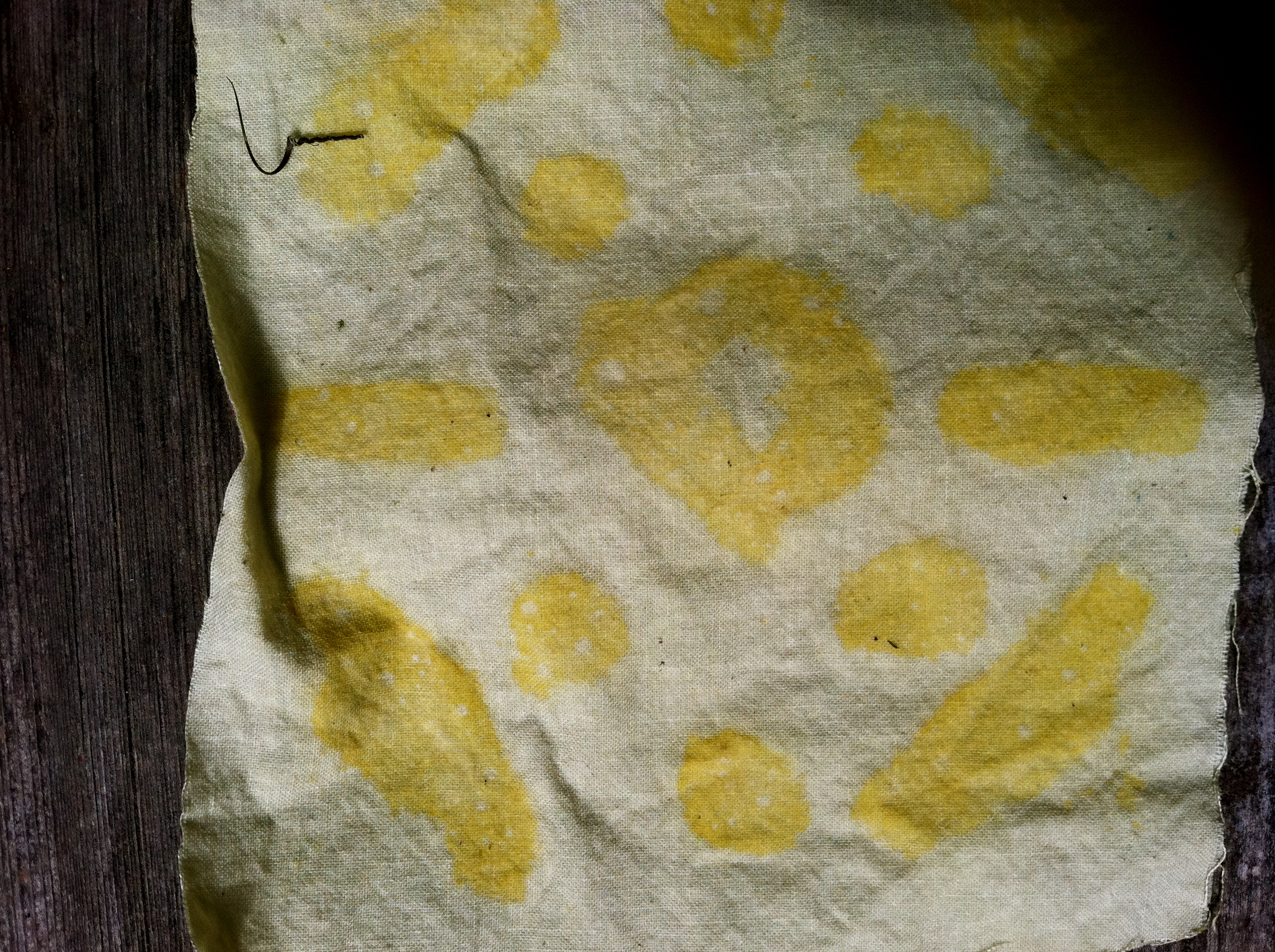
We painted with crushed stone and fruit inks… and then immersed our work in dye vats of the season.
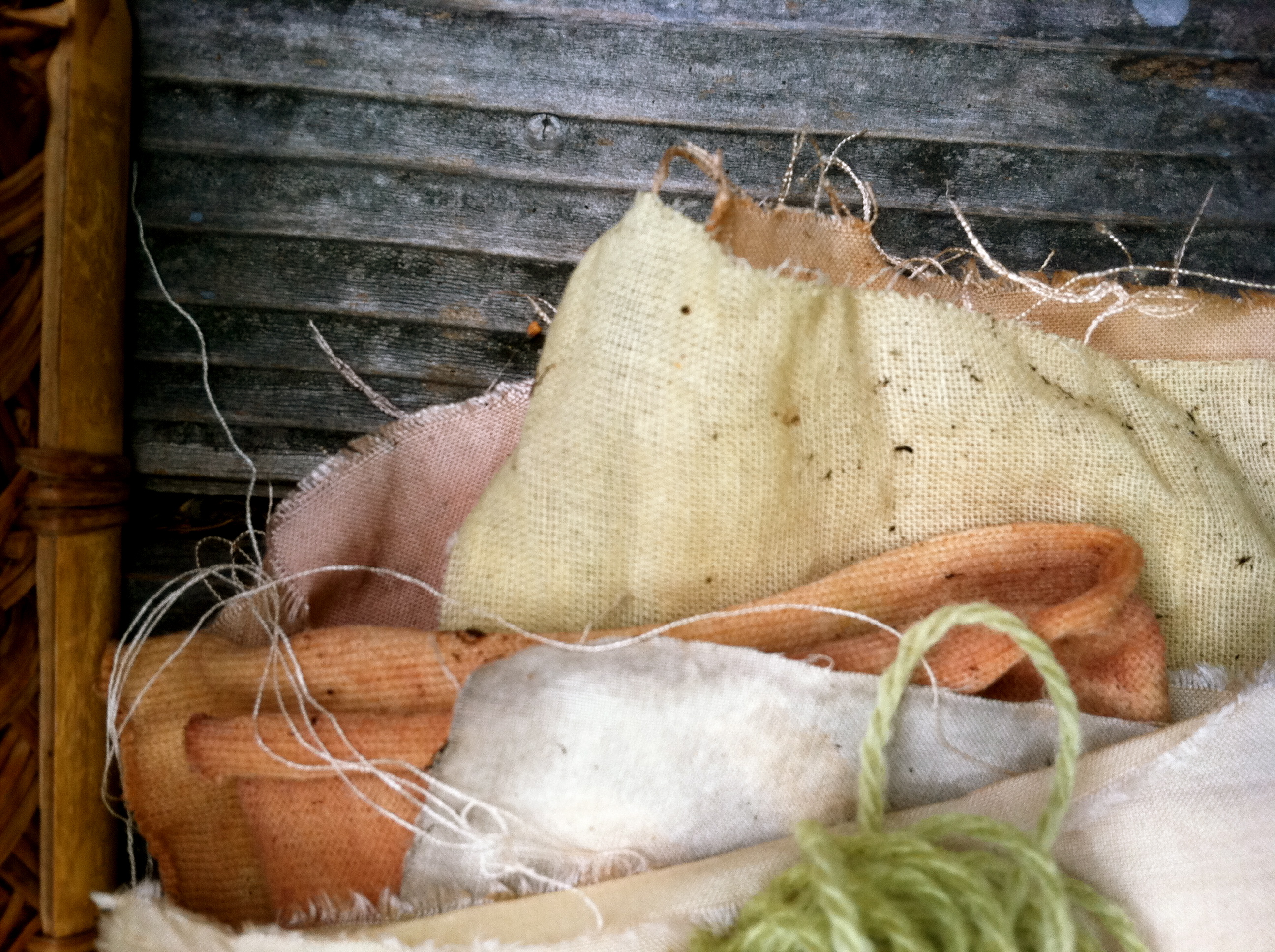
The water laden plants created a soft palate whose tones looked so much like our surroundings.

The experiments continued throughout the afternoon, the playful samples kept coming…
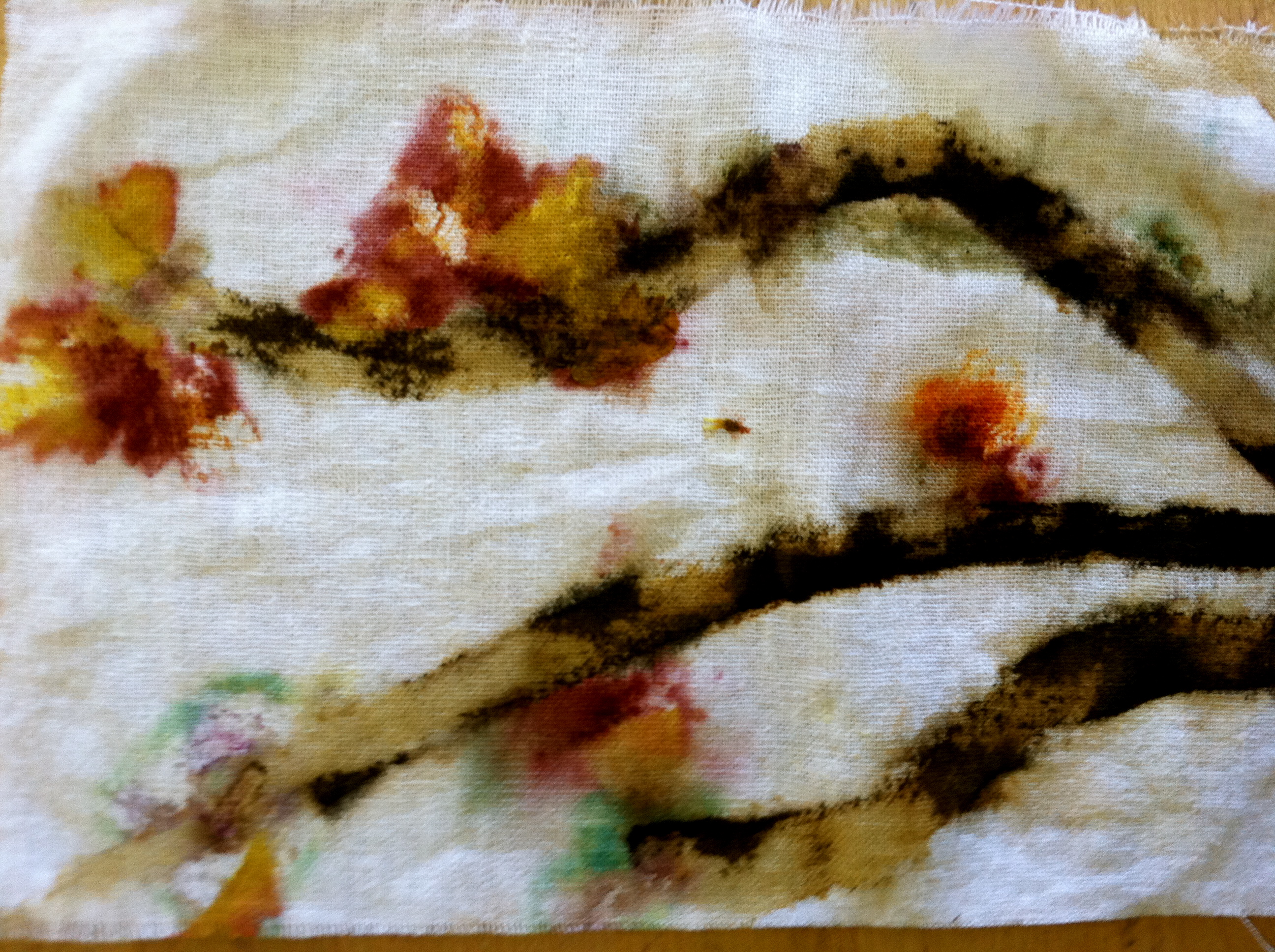 The following week, I was off to the schools.. this lovely piece was done by an 8th grade crew working on re-purposing their thrift store finds during a week of Eco-chic explorations.
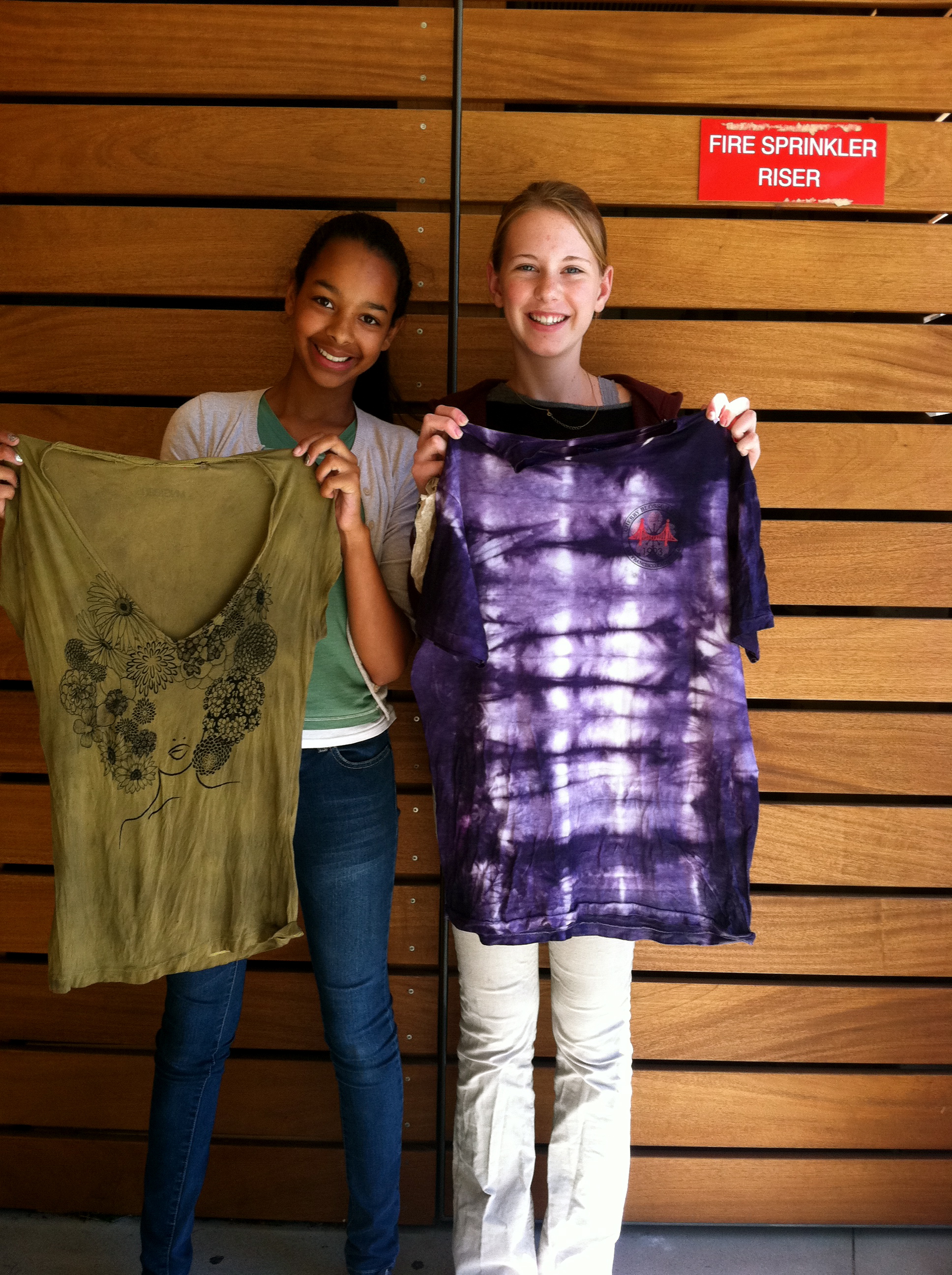
These T-shirts were in their first phase of being refurbished… the students used shibori techniques with tongue depressors and coffee stirrers. Next step: embroidery, and sewing.
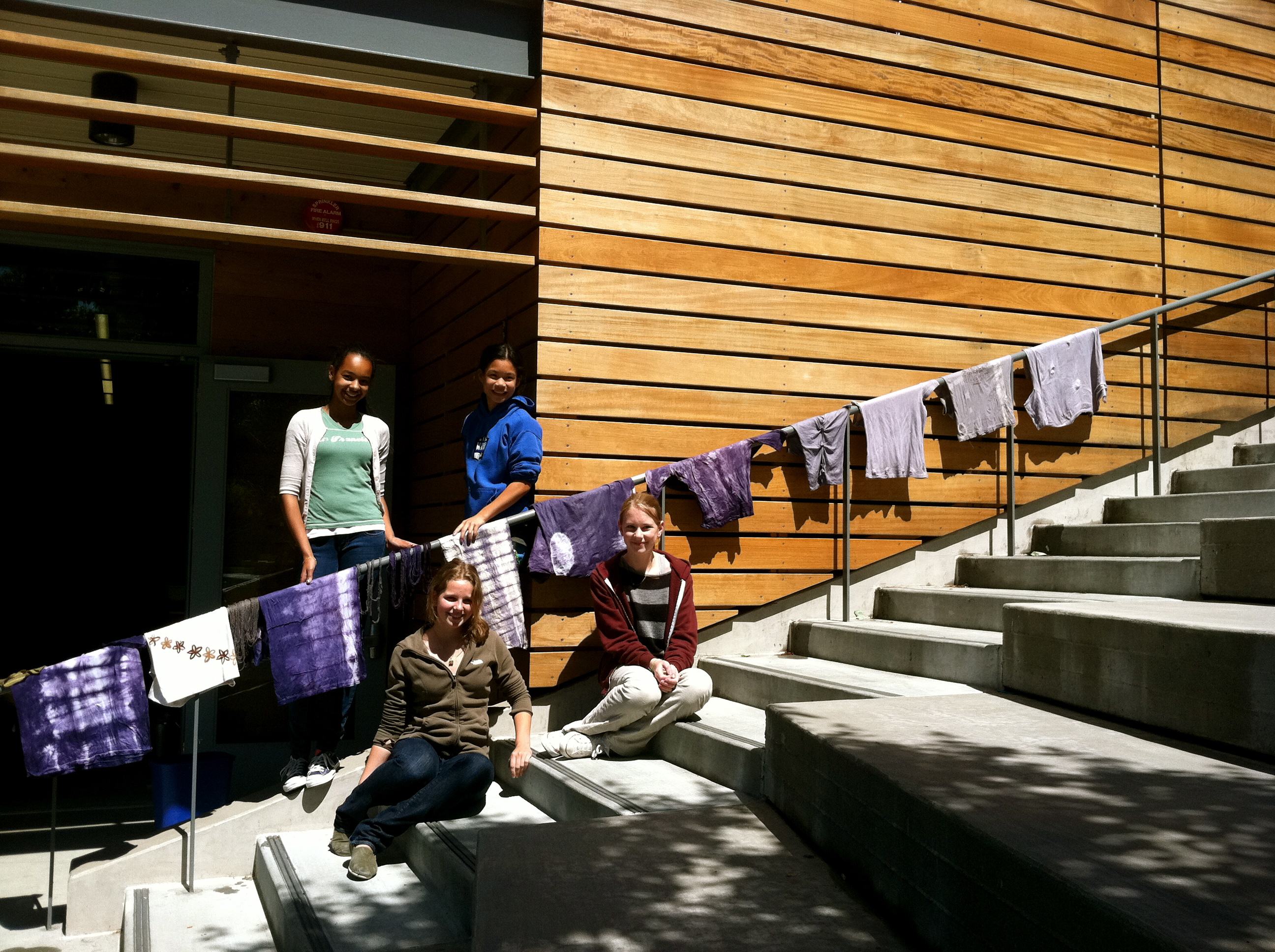
The whole collection, inspired from the spring recipe for Logwood!
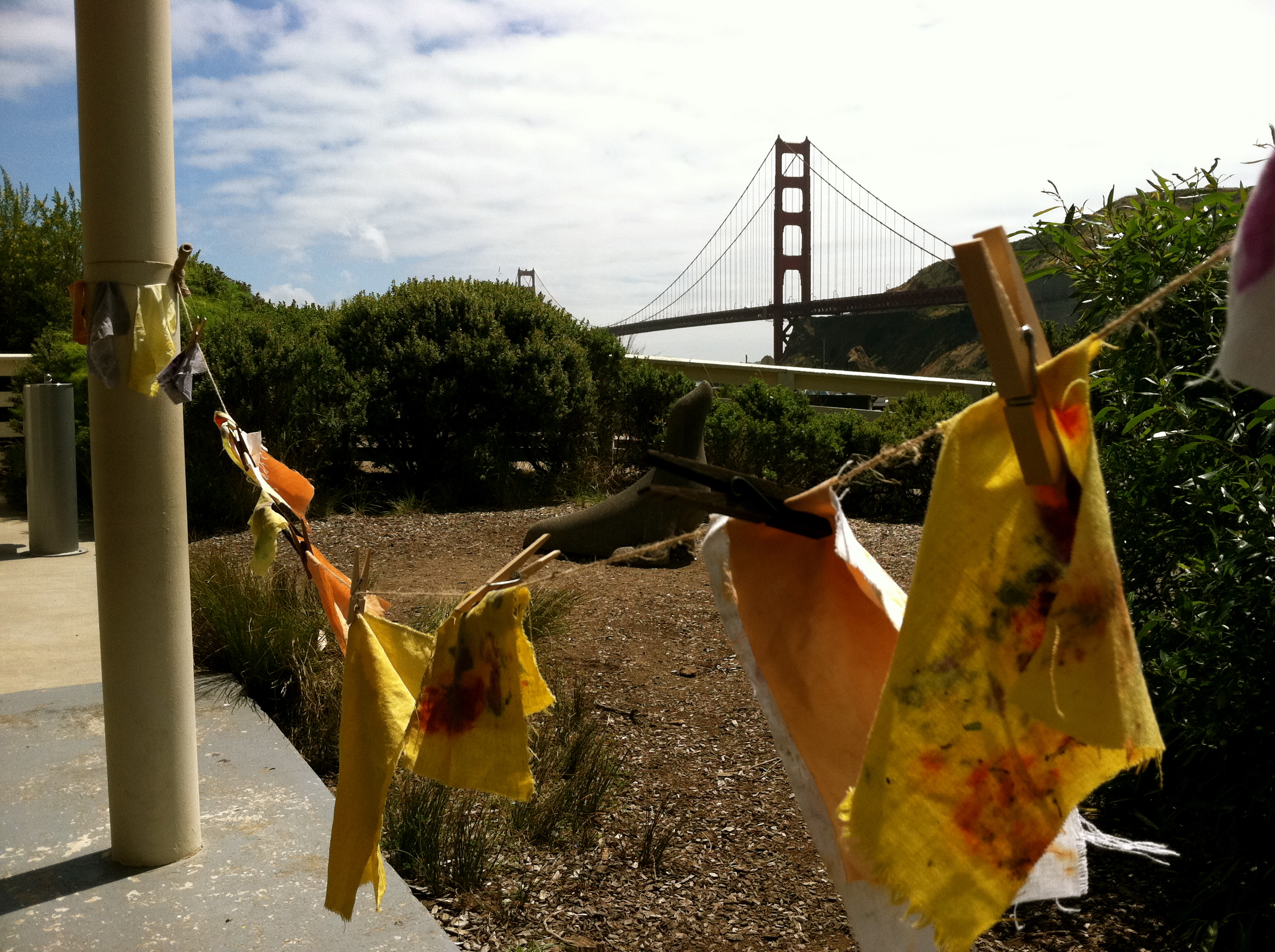
Gorgeous colors came from our Bay Area Discovery Museum dye day– the bright yellow emerged from distaff dye pots. Every child’s favorite color! It also happens to be a species that our open space districts, national parks, and other land management agencies are spraying with herbicides to remove… I much prefer dye making from such a plant. I recommend the master dye bath recipe, as well as an alkaline after bath. 
Into the distaff dye pot went our little flags.
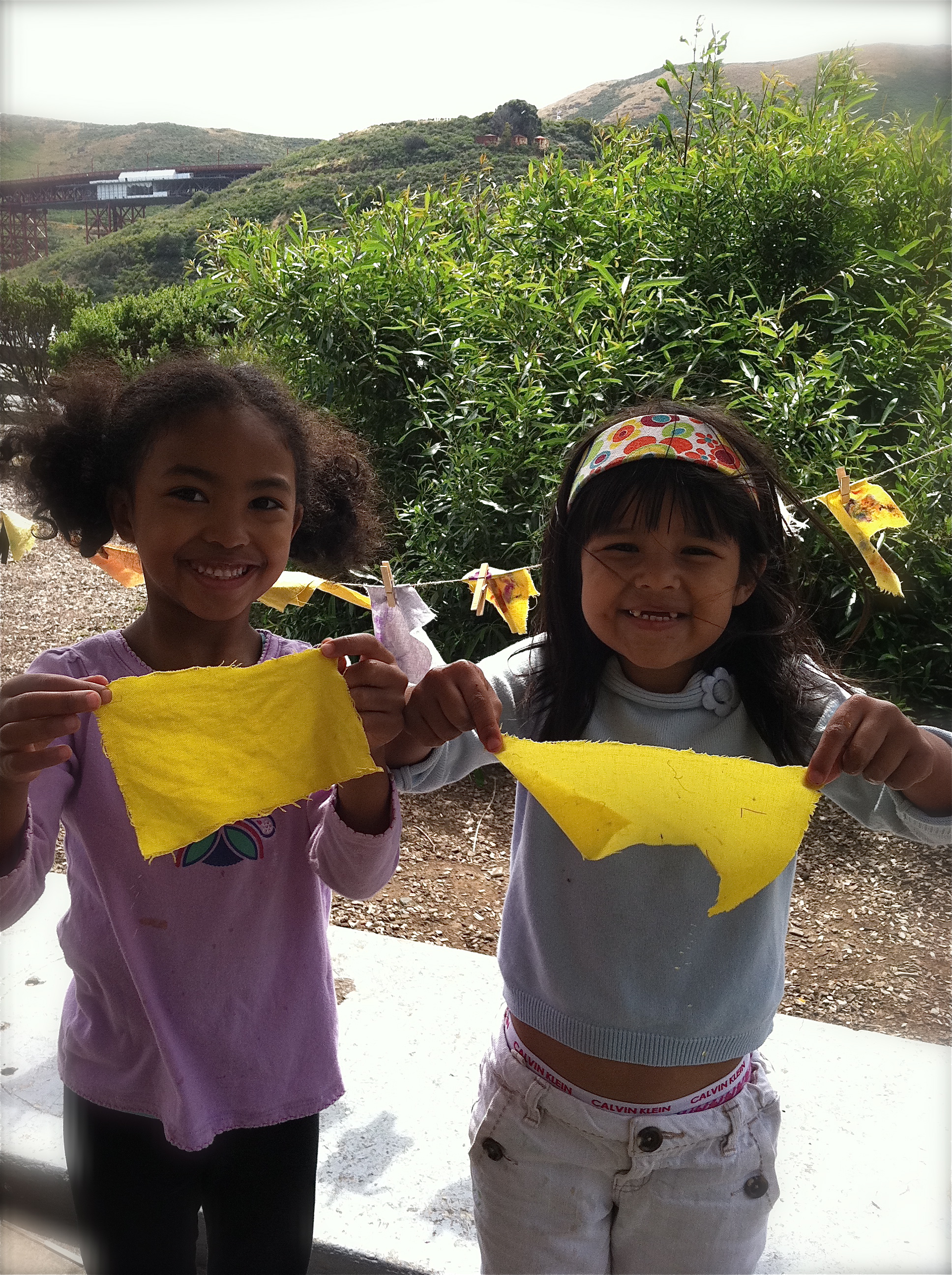
Out came the brightest yellow! Everyone was so pleased.
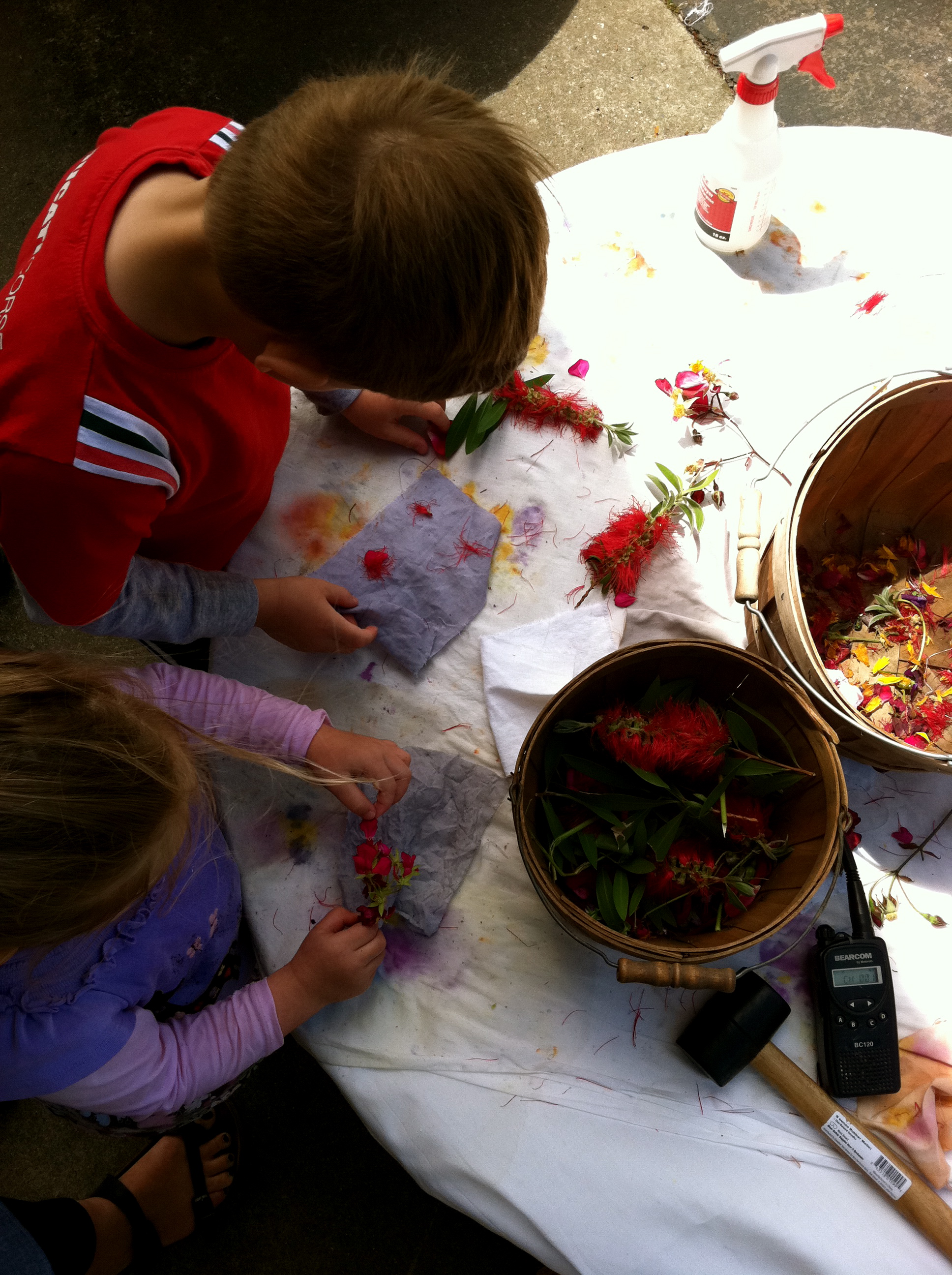
We pounded colors from our cultivated gardens into our distaff colored fabric swatches. We used the spring dye starter recipe from the new book Harvesting Color. This particular project is perfect for children and adults seem to love it too.
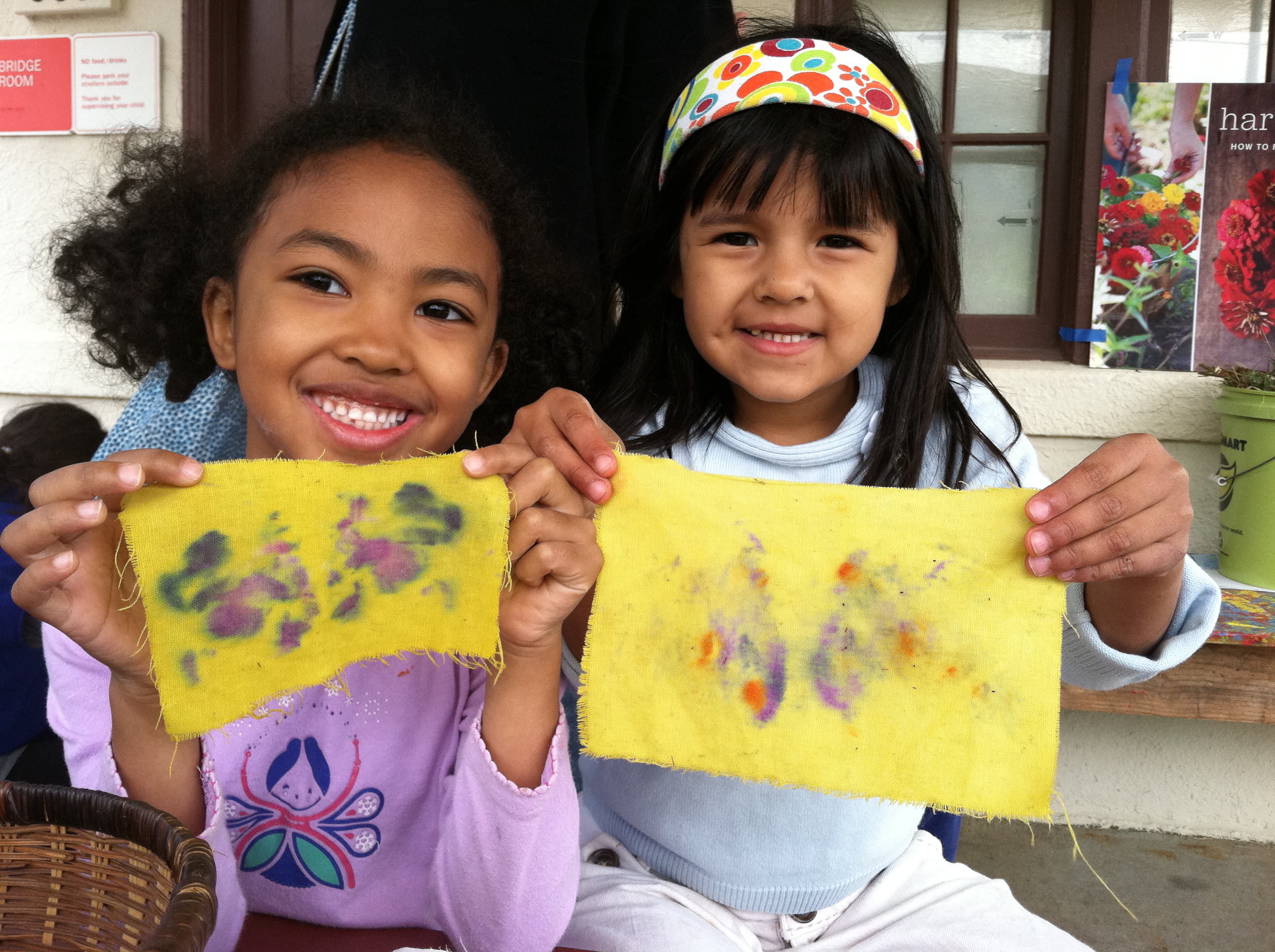
The end result…. little pounded distaff dyed cloths!
More spring dyes to come… with these late spring rains, their will be so much to harvest!
The Art of Native Ink
April 24, 2011
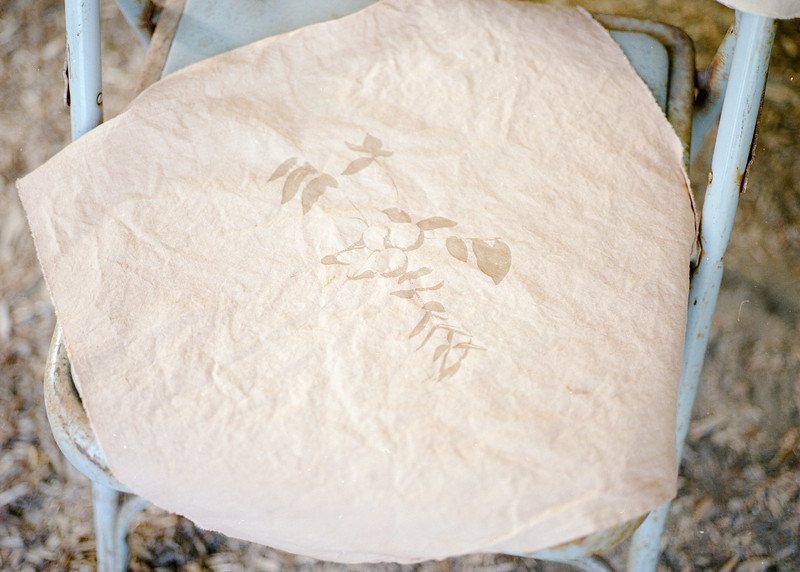
The first dye series of its kind was taught at the Regenerative Design Institute this Spring– classes steeped in processes created from the very landscape surrounding our dye pots and ink vats. Coffeeberry, Toyon, and Coyote Brush were harvested by our team of eco-art explorers.
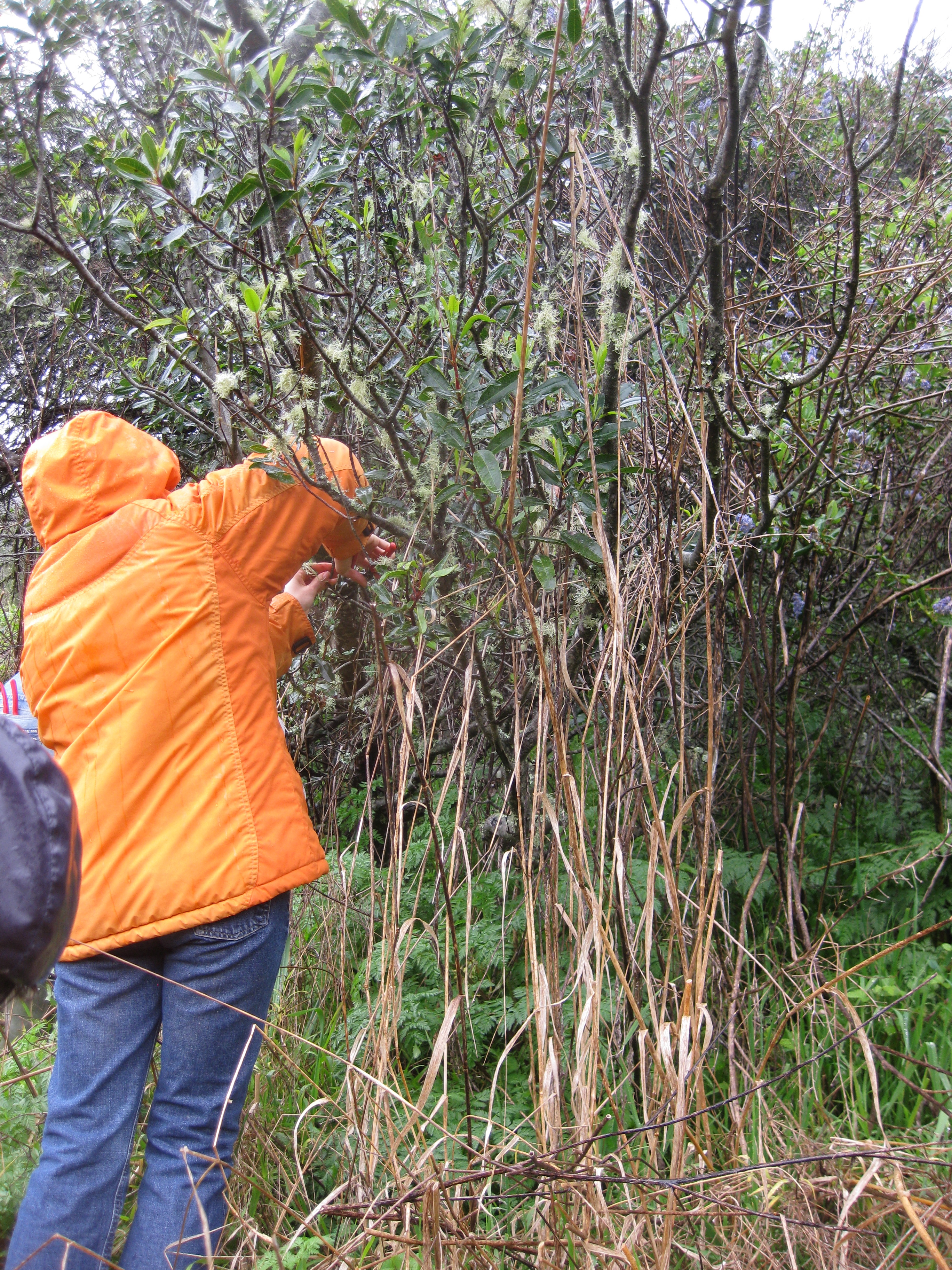
We began on a rainy day for our harvest… we gave each plant a clean-up and nice little prune.

We made our modifiers and mordants through the crushing of galls from our native black oak. A beautiful and renewable binding agent.

The copper pots were put to good use to patina our colors…. they have masterful results with the native plants.

We began to experiment with home made screens– images originally drawn by an artist and designer friend, Sierra Reading of the California College of the Arts. The images of Pokeberry and Black Walnut (both dye plants), looked quite beautiful in our coffeeberry ink.
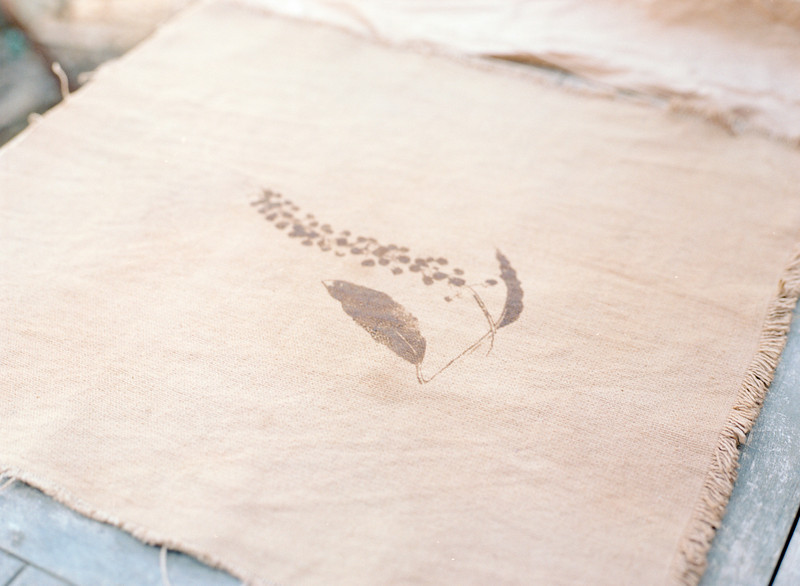 The Pokeberry image was created with coffeeberry ink on a toyon dyed cotton fabric

A lovely hand-cut printing block was used to make this design.
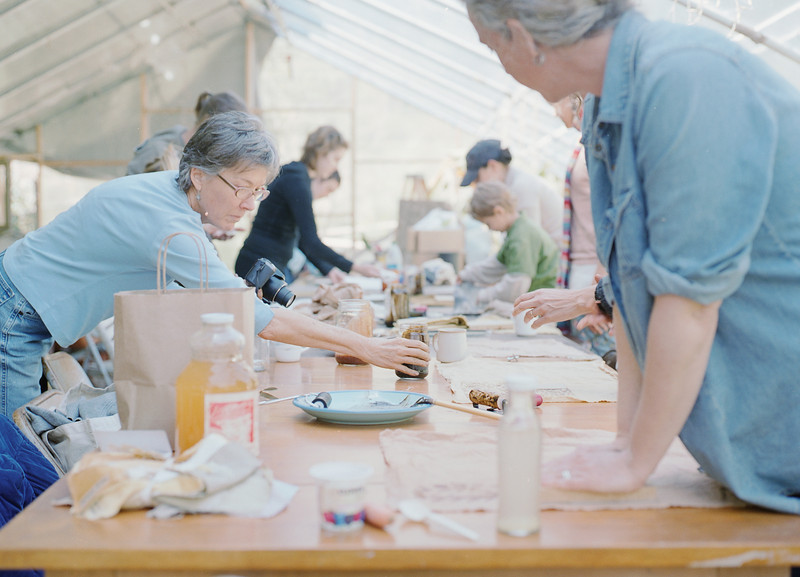
The class was intently creative….

Painting leaves proved to be an exquisite way to print…

We shared our blocks and leaves with one another.
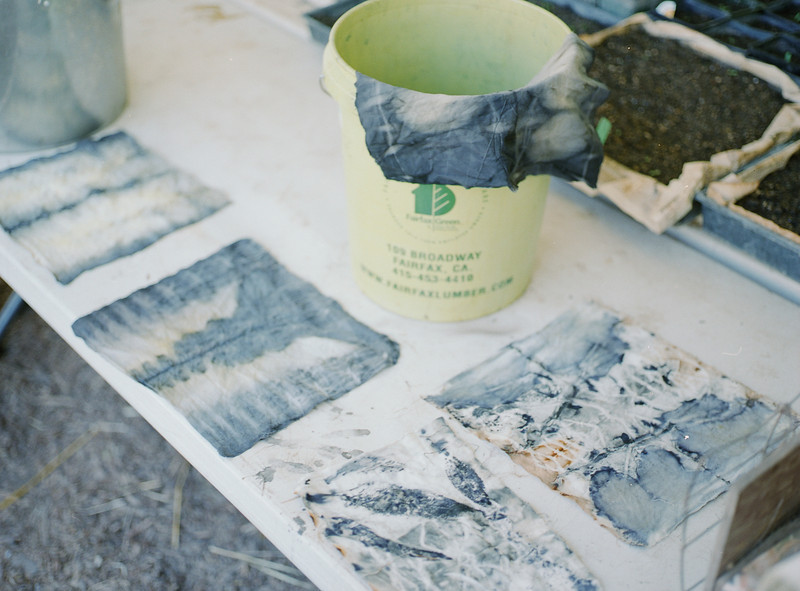
We also created some gorgeous prints without the use of blocks– just using bay leaf, eucalyptus, rubber bands, and iron rich waters.
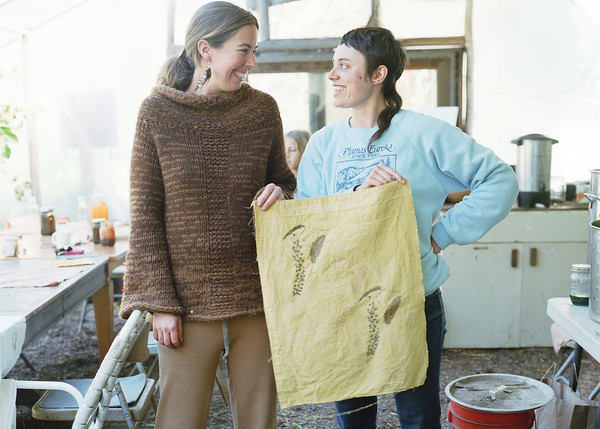
Thank you to all of the class members– your art was and is an inspiration!
Thank you to Michael Keefe for your continuous stream of good photography and support:
For more pics of our workshop: See the Smug Mug Site
Winter Wardrobe Reclamation
February 8, 2011
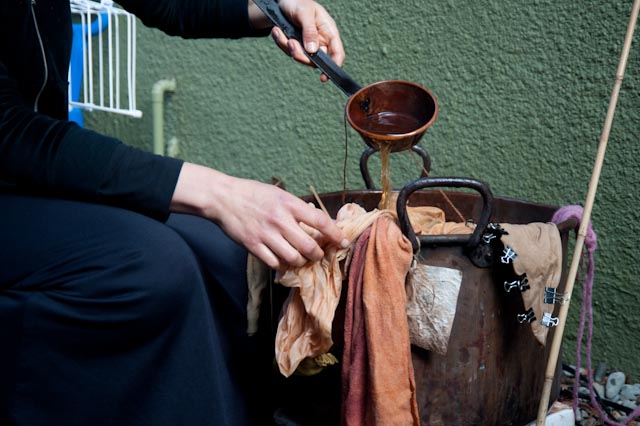
A cold and rainy winter morning blossomed like a meadow of wild color as we dipped and stirred our clothes into botanical brews. Dr. Sara Gottfried hosted a fabulous wardrobe reclamation at her Oakland home. The vats of steaming plant matter wafted like tea, and the hot water warmed our chilly fingers and hands.
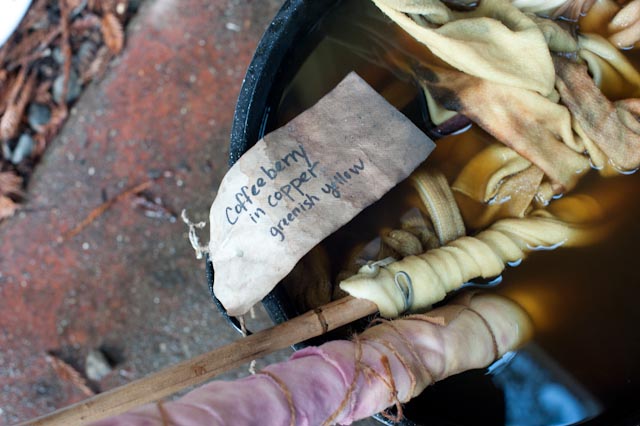 The coffeeberry yielded a magical greenish yellow. The branches and leaves came from a local ranch where a big pruning had just taken place.
 We also made use of the Valley Oak’s renewable gifts.. the galls create an incredibly steely gray color. At this time of year they can still be found dangling from the barren branches. Known as ‘an apartment building’ for insect life, the galls host a plethora of tiny species in the larval stages during the autumn.
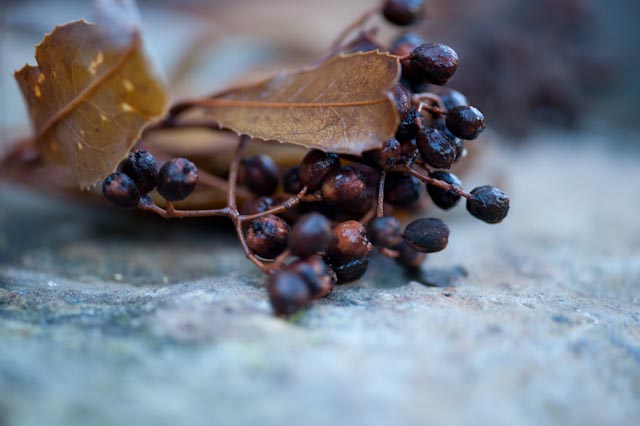
Toyon branches were collected from another pruning job. Leaving the berries for bird food is normally best… but if they are trimmed from the tree for the reasons of a landowner, they can be used in a dye pot to add a little added orange hue to the color.
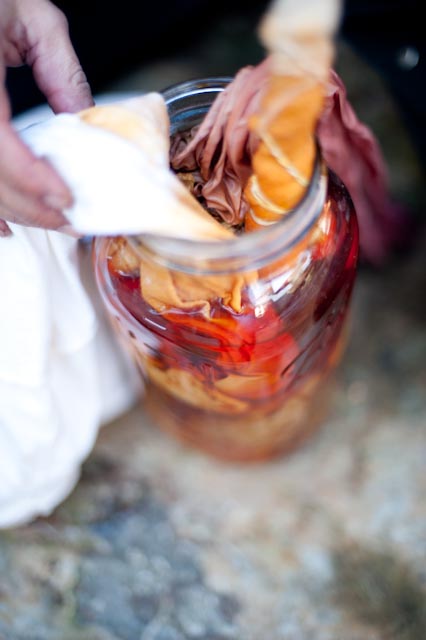 A lucky find of coreopsis was at the local farmer’s market, and was purchased just before the workshop began. The flowers create a beautiful and very strong orange dye almost instantaneously.
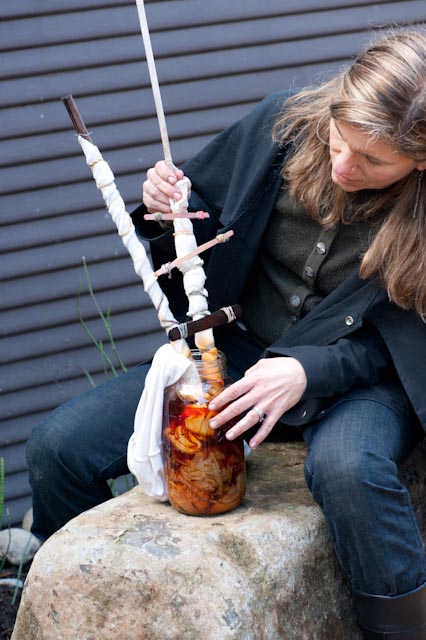
Dr. Sara Gottfried dyes a pole-wrapped garment
Dr. Gottfried’s dye work is a small step in support of her overall efforts to wear and eat organic this year. Her organic experiment, as it is known, began January 1st of 2011. I’ve loved reading her blog: http://drgottfried.blogspot.com/. It is a journal that weaves together her life as a wearer and eater of organic, as well as a doctor, a hormone expert, a mother, and an astute barometer for inspiring and eye opening books.
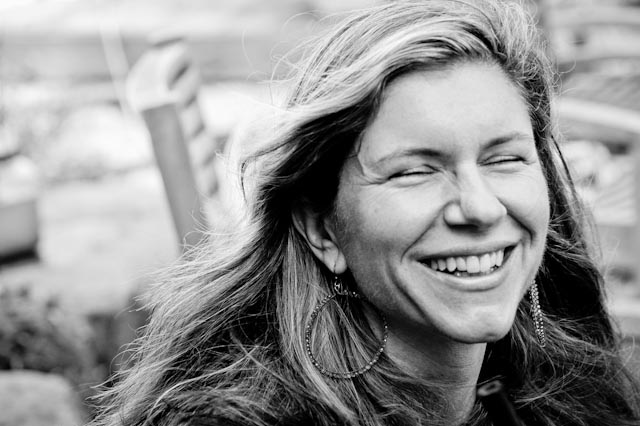
Her evolving journey rings so true and resonant to experiences I’ve had in the Fibershed project. I also completely adore her entries on female hormones, burnout, and thyroid malfunction and its causes…. all very pertinent for those of us who tend to burn the candle at both ends. The entry that grabbed me recently was her description of receiving a garment in the depths of the winter temperatures. The organic experiment took time to evolve, and winter was already here. After a week or more of coldness…
“All changed yesterday when my organic, fair-trade sweater showed up in the mail. The world brightened. Slipped it on at the UPS store. Fit gloriously and within seconds.” –Dr. Gottfried
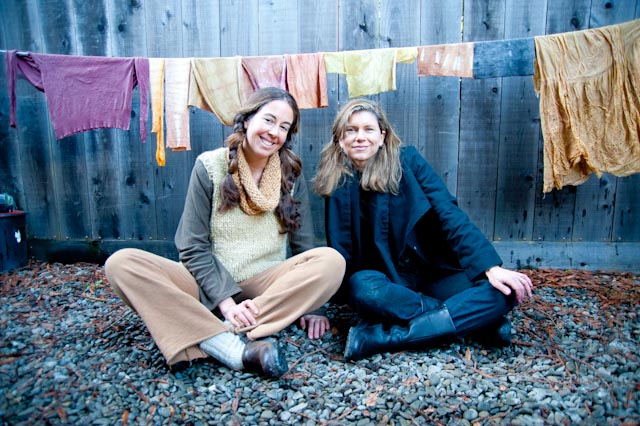
Left: Rebecca Burgess wears Sally Fox cotton pants, fennel vest, toyon neck cowl, and an oak gall shirt. Right: Sara Gottfried wears a fully organic outfit, jacket was locally designed and sewn
Self-imposed limitation creates this kind of gratitude and joy. I know this feeling so well. It is a pleasure and a gift to be able to share this feeling with Sara. I feel a sense of respect and total admiration for her efforts and journey. It’s good work, not always easy but incredibly worthwhile.

This experiment means supporting the movement away from that which has the potential to disrupt our most sacred balance, and personal energy resources. To remove the synthetic compounds from our diet and clothing is a process of giving ourselves those things we are intrinsically designed for–natural fibers, and clean food. Good for the inside, good for the outside.
Thank you Sara for inspiring, illuminating, and teaching through what you know, and most importantly, what you do.
Thank you Madeleine Tilin for you amazing photography!

Toyon & Chromatography
January 9, 2011
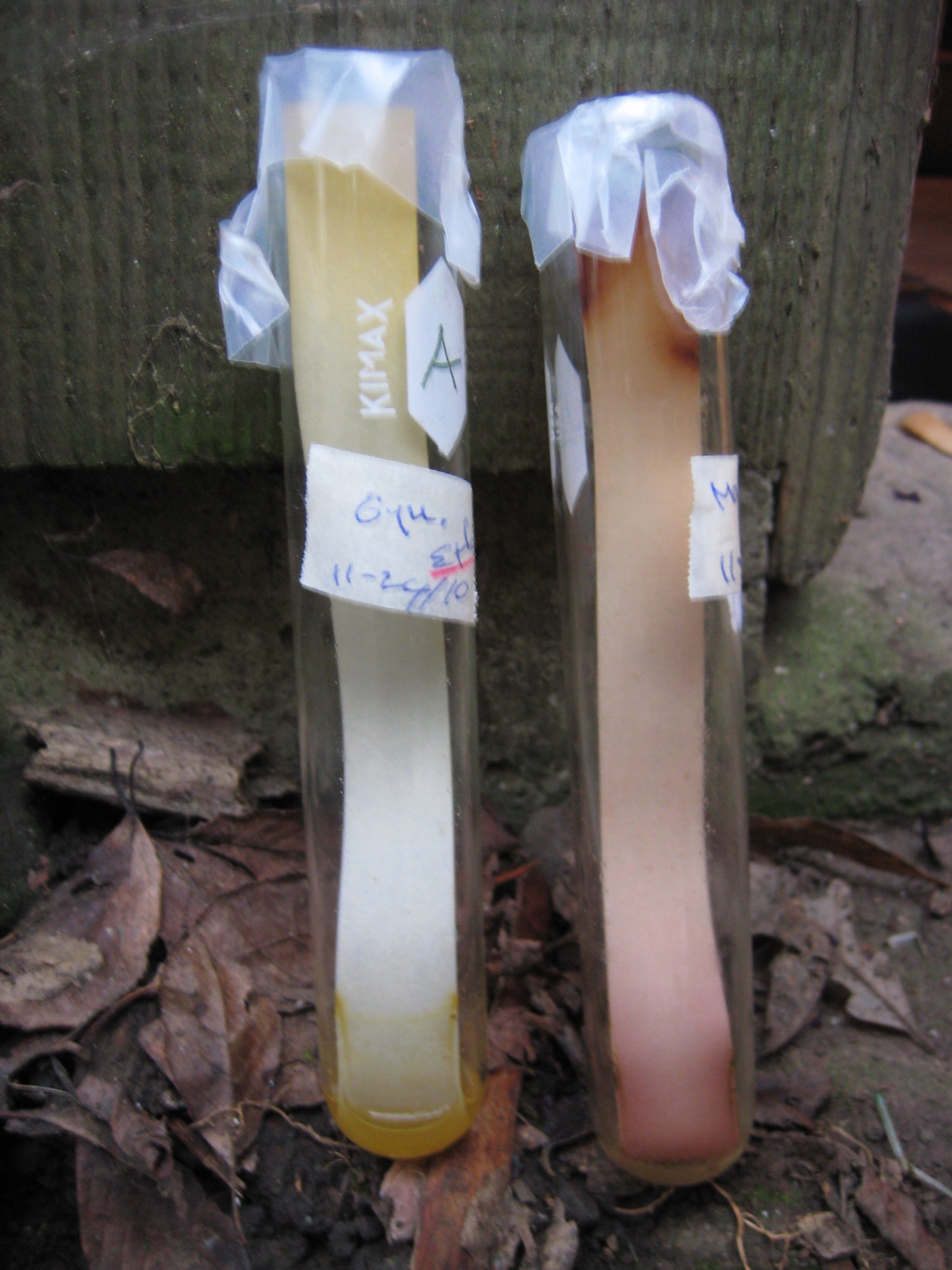
Have you ever wanted to assess the plant species in your region for natural dye capability? I certainly have! I also have had the interest to see if there are colors that I have not achieved in the dye vat that are secretly hiding out somewhere… waiting for the right protocol. For these reasons I started collaborating with a local biology professor and doing some very basic chromatography experiments.
Through the harvest of just a handful of plant material you can conduct a simple experiment to see what colors lay beneath the surface.

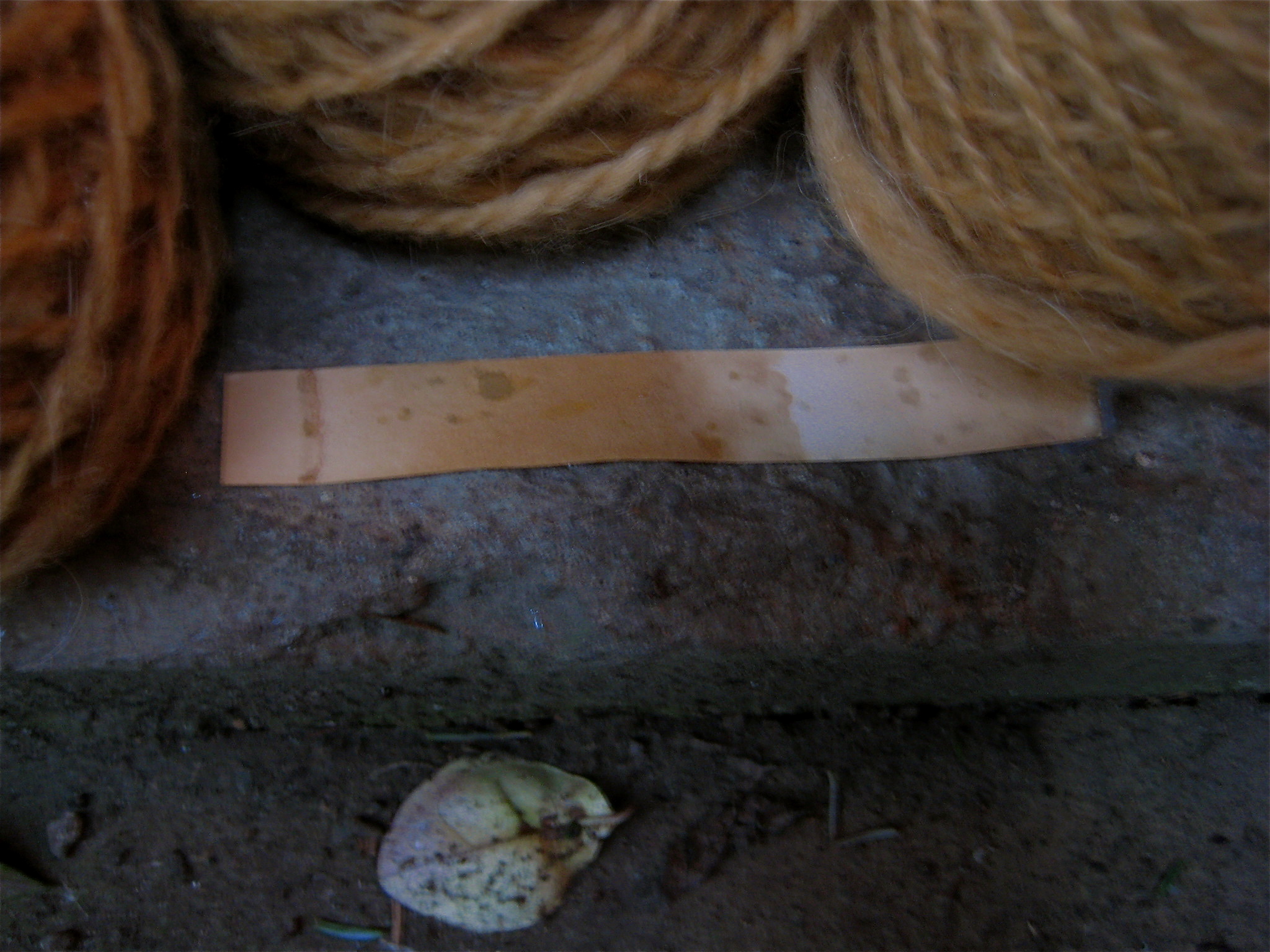
Here lay three handspun toyon dyed skeins, and s sprig of the plant, along with a chromatography strip. The definition of chromatography… ‘a process used for separating mixtures by virtue of differences in absorbency’…
The chromatography strips created with toyon leaves were representative of many of the colors that I have already discovered. The bulk of the color on the strip is a rusty orange– which is a common color achieved with toyon dye. Towards the end of the strip, there is a small area of pink— a very new and curious color!
I began to play with the water of cooked berries (which are edible if roasted or boiled), and achieved these colors (as seen below)..
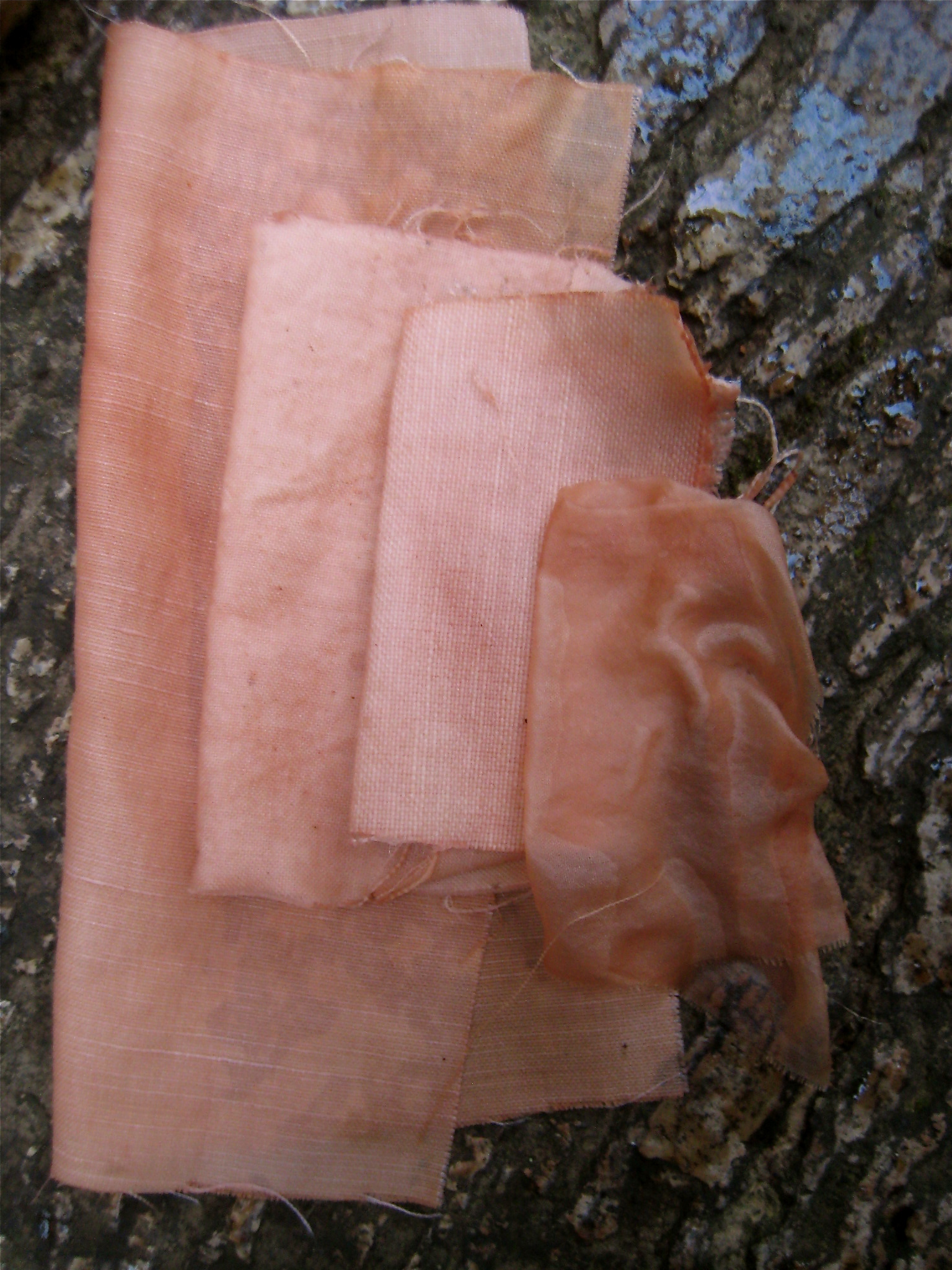
These pinks were abundantly available from the berry water, and showed up on linen, silk, and cotton samples. My question was if it was possible to achieve the pink tones without the use of berries, (I prefer not to use berries for dye– because they are such a nice food source for birds and people).
This experiment is being continued… and was further explored at the seaside day of dyes. I brought toyon leaves and stems that had soaked on slow heat for days..and within a copper pot. Something about the copper, ocean water, and leaves, all combined– yielded some exquisite results, far beyond a simple orange or pink.. the color lived somewhere between the two. If I had not experimented with the chromatography I’d have had no sense that these colors were possible… the beauty of the scientific process, is that it shows you what might be available to you in the dye pot. You are, of course, then left with how to achieve those results, and that is often where the fun begins.

The experimenting continues.. and if you’d like to try your own chromatography experiment:
Grind 5 or 6 leaves in mortar and pestle
Cover the leaves in alcohol (medical grade)
Let sit for 24 hours or longer
Pour liquid into a test tube
Place chromatography paper into the test tube, cover, and wait
I recommend several days, even a week of absorption before removing the paper
Frozen Pokeberries & Oak Galls
January 1, 2011
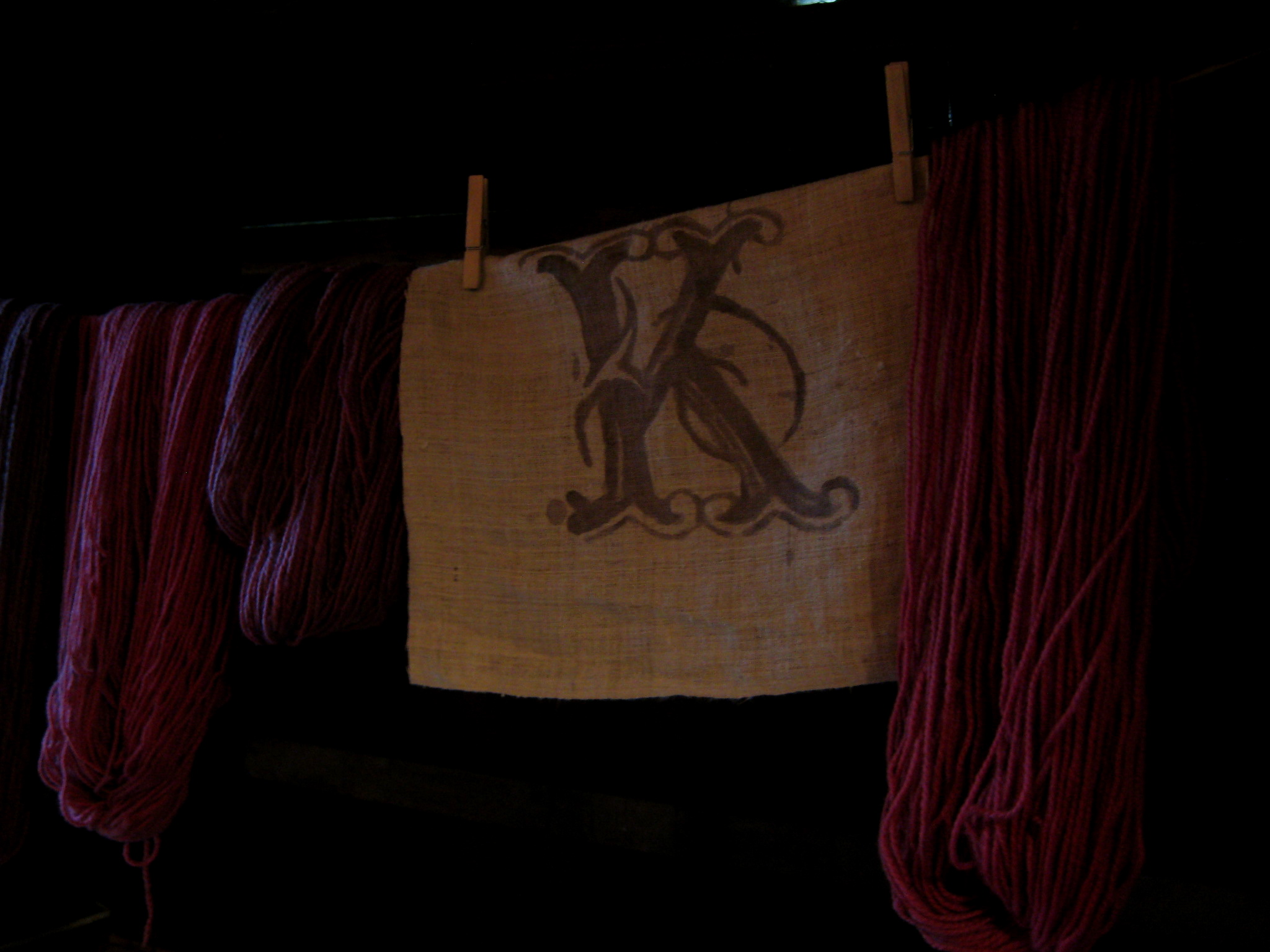
Its a bit cold, and as you can see from this picture.. it’s dark too! The winter has moved many dye processes inside. As it started to rain a few moments ago, I pulled everything off the dry line and moved into the studio/garage. The wool has just come from a dye bath of vinegar and my frozen pokeberry harvest. (My gorgeous 7 ft. tall plant, was dripping with berries this last autumn), I froze them and was waiting for the perfect wool to dye them in. These skeins are from Reba, a lovely merino sheep who lives in Mendocino County, CA.
The letter K is a screen print that my brother and I created for my mother (Kerry), for Christmas. I made a glorious ink with galls from a very manganese rich soil. This ink has become a silk screen dream. I am very happy with the outcome. It can undergo all kinds of washing and still hold a solid slate gray tone.
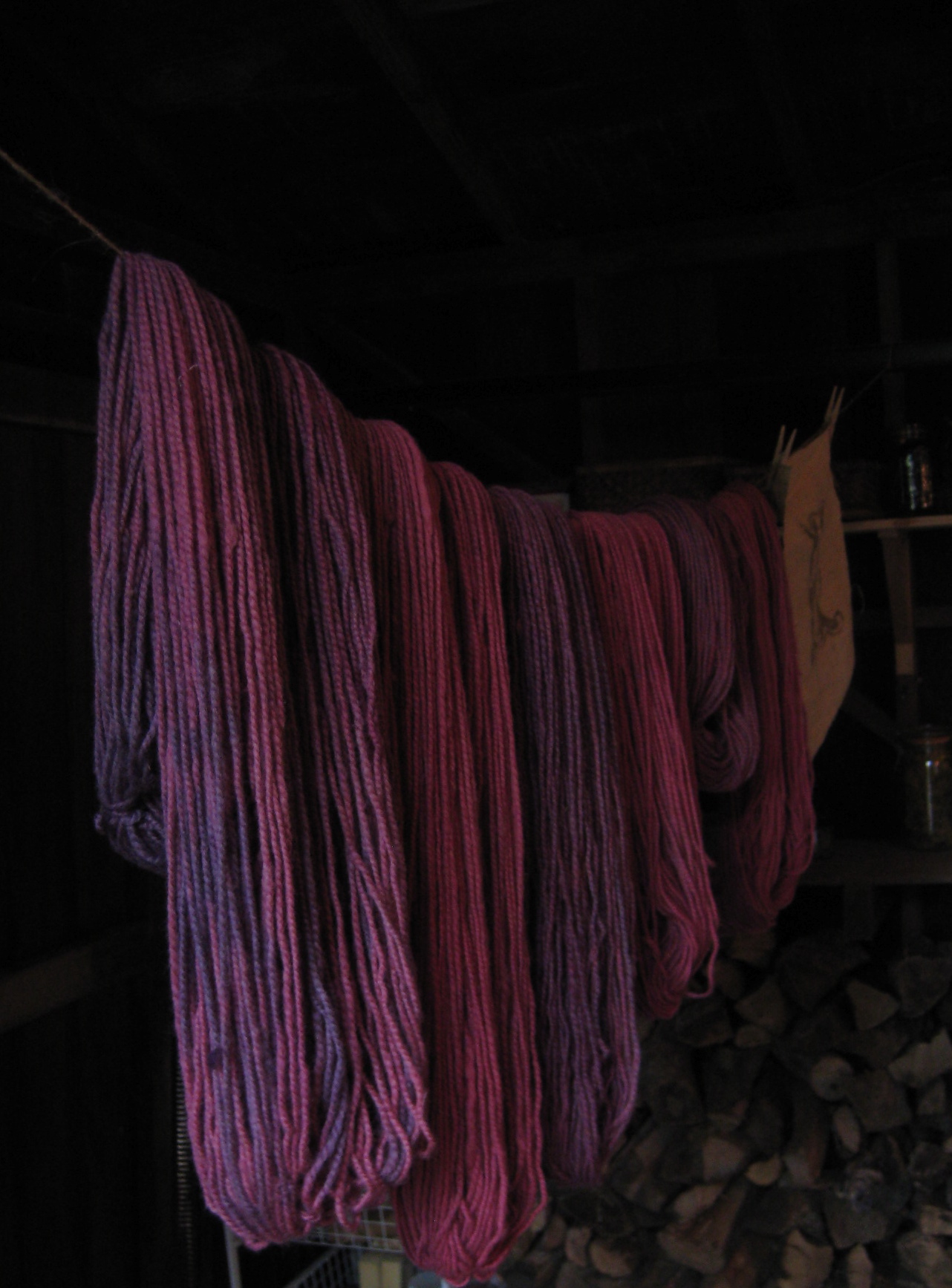
As you can see here the pokeberry wasn’t the only dye color I used. As I began to exhaust the bath, the pink turned lighter and lighter, so I quickly dipped a few of these into my indigo vat– giving a modeled and violet hue to the wool. I can’t wait to see this wool turn into the designer dress that its being created for! More on that later..
Indigo in the Rain
December 18, 2010
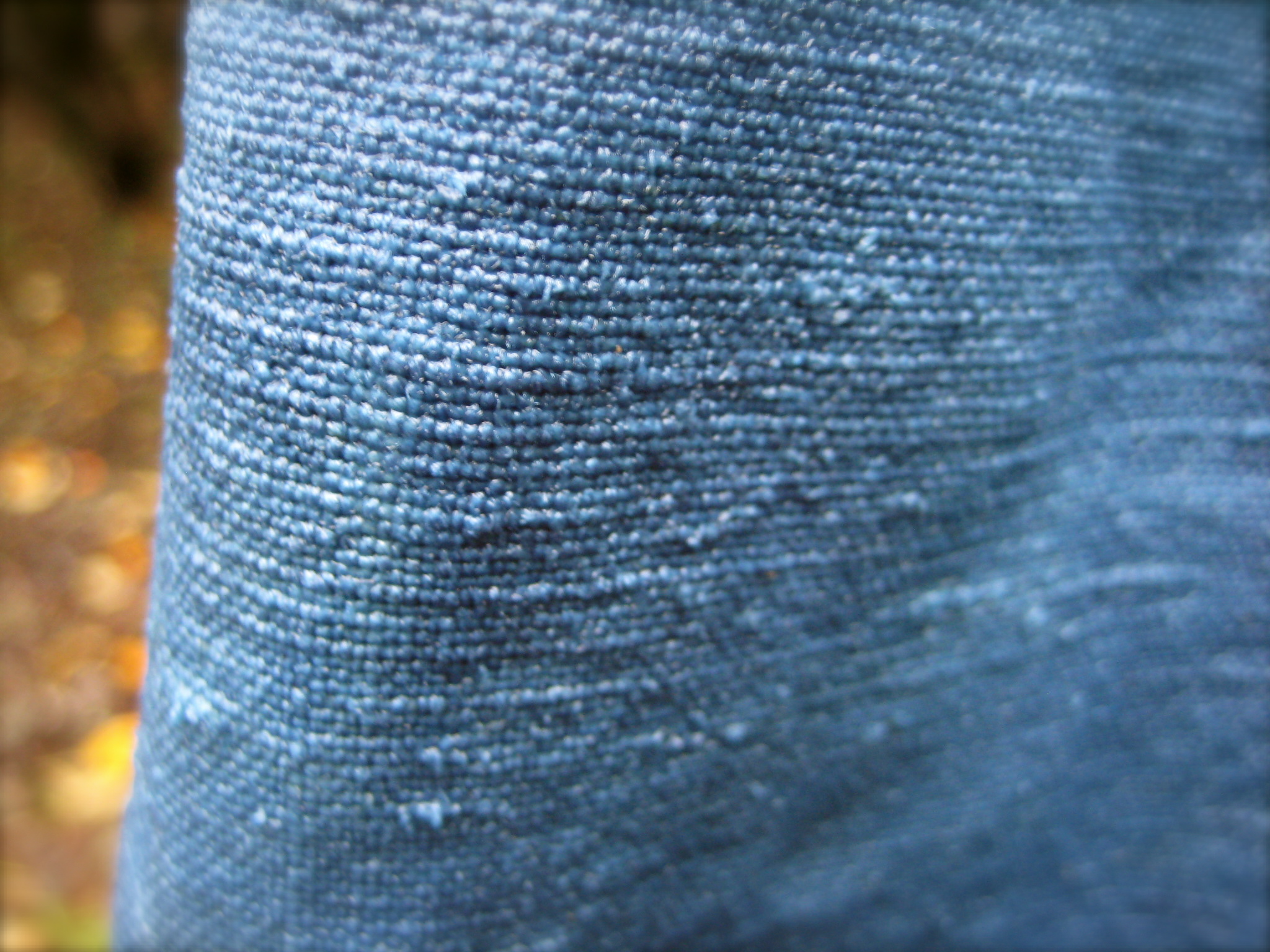
It’s a rainy Saturday, the gray and blue of my surroundings have inspired me to the indigo vat. This is a French linen for the designer Heidi Iverson. We are collaborating on Fibershed projects, and this dye work is apart of our trading process. I have dipped her dress a couple of times so far, and was moderately happy with the results. I dip the garment 1/3 at a time, due to the size of the vat, and the quantity of linen. As I keep re-dipping, the blues are deepening, and the variegation lines are becoming more pronounced. It’s a beautiful process to say the least.
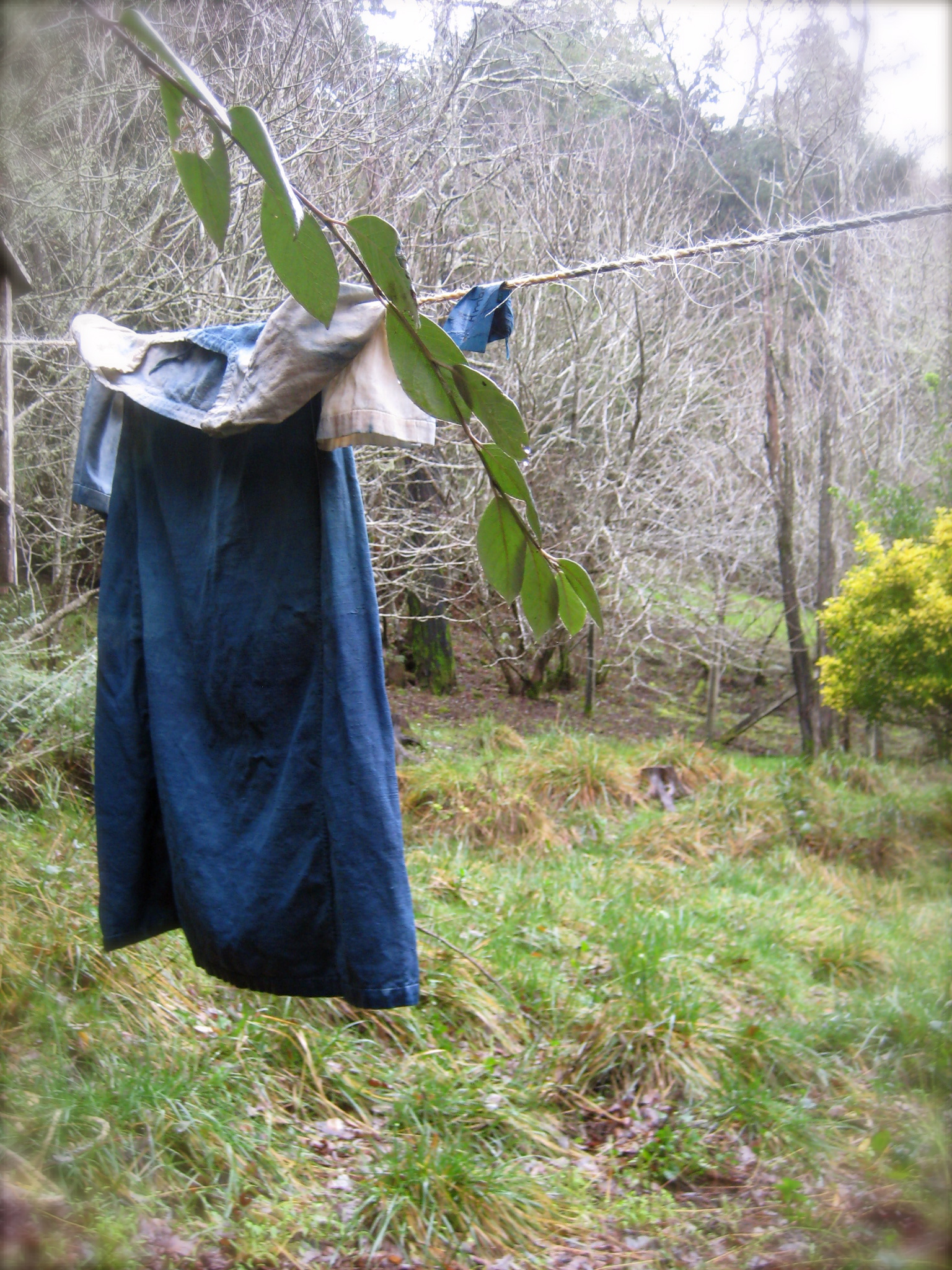
The dress hangs above the forest floor– which is graced with a native sedge that I have yet to identify, but am so in love with. The creek was running full this morning, I awoke to the sound of water pouring over rocks– when I went outside the air temperature was surprisingly warm. It is such a blessing to be in the forest, and watch the water absorb into the soil, grass, and creeks.
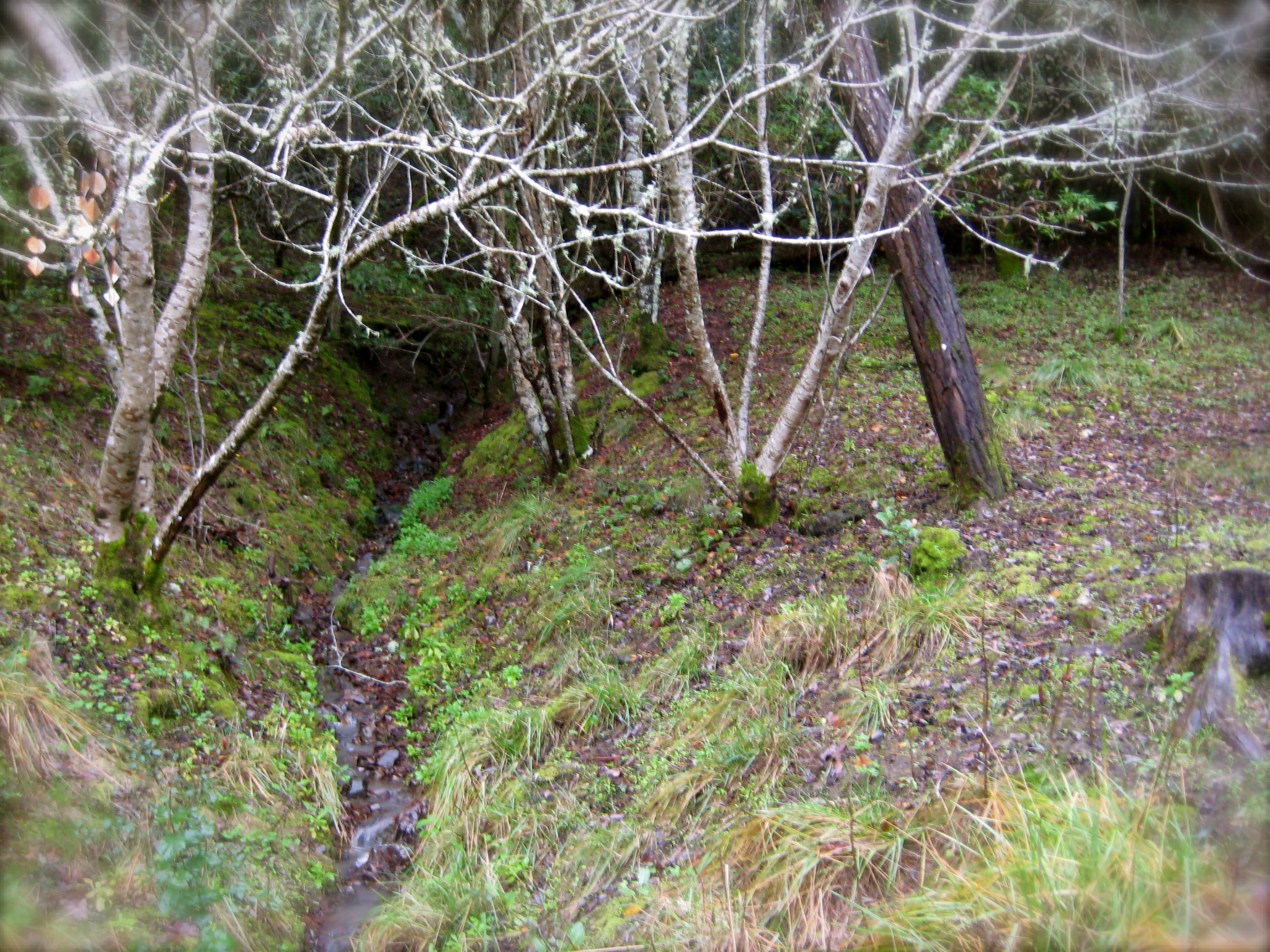
The little creek that runs through the land, making an abrupt turn just before the house. I am settling into my new home, becoming familiar with the new climate, the plant life, the fauna.. it is an inspirational environment; from which I intend to create many beautiful colors to share with you as the season progresses…
First Indigo Workshop
November 5, 2010

Our indigo crop at Mt. Barnabe
Indigo is being harvested for both seed, and there is some very nice fresh leaf in the field— still perfect for the making of sukomo (indigo balls). In honor of the harvest, we had our first indigo workshop at the Regenerative Design Institute. It was well attended, by a very talented group of artists, professional designers, permaculturalists, and teachers.

Everyone had the opportunity to clean their own seeds, and take home some of the fresh Polygonum tinctorium for their own home gardens. Growing our own blue is a step toward a regenerative color base, that is not reliant on unhealthy concentrations of heavy metals– or petroleum by-products.

Along with immersion processes, we also made an indigo paint for use as a surface design feature.

Here, indigo is painted onto a hemp cotton.. the oxidation occurs after the brushwork is complete. Turning your work from a yellowish green, to a deep blue, right before your eyes.

Indigo Paint was used here over an immersion dip in a fermentation vat.

This creative piece was constructed with both shibori techniques and beeswax batik processes.

A shibori heart- made by a true resist dyeing professional!

Gorgeous batik… dipped in fermentation indigo.

Another example of a batik process dipped in fermentation indigo.

As we left the Regenerative Design Institute a fresh harvest of apples, greens, and goat’s milk whey had been lovingly displayed, for us all to enjoy, and take home.

On the way home, through the Bolinas Mesa.. enjoying the sunset through the bank of fog.
Thank you Erin, Penny, and all of you wonderful participants!
A Season of Botanic Color
November 2, 2010

photo taken by Dr. Sara Gottfried at her model platinum leed Oakland home
There’s been five fabulous workshops in the last three weeks– and I haven’t been able to document them all. However– what pictures were taken I now have the privilege of sharing with you. This autumn has been a complete inspiration for me as a lover of natural color. The students created so many new samples, and finished goods to awe over…

photo taken by Dr. Sara Gottfried
Sara’s pants were soaked in iron and then dipped in fair trade logwood from the Dominican Republic. A one-of-a-kind gorgeous creation.

A cotton sample freely printed by a student with found-object iron acetates, and an immersion dip…

photo taken by Dr. Sara Gottfried
Sara dipped her silk in native coffeeberry and logwood after she and her daughters wrapped it and secured it with little stones.

photo taken by Dr. Sara Gottfried
The preparing of the black walnut bath. After some soaking and boiling these husks turned our fabrics into a range of deep and lighter shades of chestnut brown.

Rows of Native Color + Indigo: Jeannie and Marie created a very organized row of samples– the bottom row was dyed in black walnut, the next row up was dyed in coffeeberry, the pinks were dyed in horsetail, the blues—in indigo, and the top row was dyed in madrone bark. The samples were done on handwoven hemp, cotton weaves and knits, silks, – and cotton hemp blends.

A simple coreopsis flower bath turned Geraldine’s pole wrapped silk into a lovely golden sample–reminiscent of the falling leaves dusting our sidewalks.

photo taken by Dr. Sara Gottfried
Sara’s horsetail shibori shirt– this is my absolute favorite dye this season. Normally I harvest it in the late spring.. and realized this year, that it is still producing amazing color well into the fall. I wonder where the pink is hiding within this 380 million year old species.. it has so many stories to tell, if only its DNA could talk in a language I could understand!

Thank you Dharma Trading Company, Gottfried Center for Integrative Medicine, Harvard University, Lambtown, and the Regenerative Design Institute for sponsoring, supporting, and giving such an incredible foundation for natural color experimentation this season!
Dye Days at Harvard
October 25, 2010

I travelled to Cambridge Massachusetts last week to teach natural dye labs for students in the Visual and Environmental Studies program. My days were invigorating, from the architecture of the building where we convened.. the conversations with students and professors. Inspiration permeated the hours and days.

I shared my work on the intersection of art, chemistry and ecology through a narrative based presentation, as well as a series of hands-on application processes. Above, the work of our immersion labs. Students worked with plant species native to the northeast, as well as California. One of the cosmos species we used, was being cultivated in the Harvard school community garden.

The garden was started this year as a part of a University wide project led by the Center for Health and the Global Environment at Harvard Medical School. The well-tended beds were laden with food, and unbeknownst the gardeners… dye plants too!

Here lies a beaker filled with cosmos dye- an easy to make concoction, with a readily available species. The basis for a beautiful golden orange color.

Here is a pokeberry wash we made.. used on paper and on fabric. The berry can be found throughout the region, and is native to the Cambridge area.

We also covered the use of both common and not so common tannic compounds for use in painting and printing. Students explored variations in color provided by pH as well as mineral mordant applications.

The beauty of abstraction.. all the tannin pieces were created on unmordanted organic cotton canvas. Students explored the possibility of non-toxic painting .. based in the use of highly renewable resources.

The use of homemade iron and alum acetates proved to work beautifully on organic cotton muslin. This piece was a combination of stamping, immersion, and shibori work– a very unique blend of materials and processes.

Our last immersion lab proved to be an especially creative block of time.

We made a completely non-toxic instant indigo vat, that everyone was able to use within minutes of its creation.

Some of the immersion processes…

A combination of the printmaking and immersion lab samples where laid out together in this image. A compilation of earth pigment paints, acetate printing, and immersion vat dips. A colorful and diverse array of applications.

Before I say goodbye..I’d just like to thank those who made these labs possible– Helen Miller, Helen Mirra, Matt Saunders, Josh Hart, and Aurora Andrews– you are amazing….
Late Summer Oak and Cosmos
October 14, 2010
 The fecundity of fall–a time of vibrant color from the living and the dead. The cosmos flowers are giving their last hooray before the close of the warm weather. Orange petals abound– the source of a beautiful range of yellow, orange, and gold dye colors. These flowers can be dried or put into the dye pot right off the plant.
 Oak galls can be harvested in plenty this time of year from the forest floor. They are so extremely abundant– and rich with tannins. The compounds they contain produce a range of dark silver grays, and almost-blacks, depending on how you process them.

Pouring hot water over the flowers and letting them soak for 20 minutes is enough time to create a dye color.

This cotton sample was washed– and left unmordanted before it was painted upon. Oak gall and iron water was brushed upon it (the black), the cosmos flower dye was brushed on top. After rinsing, this was the outcome.

This was the oak gall and iron water that was thickened and then screenprinted on a washed and unmordanted piece of cotton. This simple form illuminates the beautiful and strong color that emerges from the gall.
Dyes and Medicine
September 25, 2010

A day at the California School of Herbal Studies proved to be the highlight of my late September. It was an incredible day spent with 16 herbalists, all learning the art of natural dyes, (most of them for the first time.)
This workshop was accompanied by a powerful presentation given by Dr. Sara Gottfried. Together, she and I collaborated to bridge the issues of health and the reality of our clothing. Sara’s clinic, the Gottfried Center for Integrated Medicine specializes in supporting individuals to thrive and remain healthy in the face of mounting environmental challenges. Her molecular understanding of endocrine disruptors, and the effects of heavy metals shed a new light on the reality of our well-loved clothes, particularly, our jeans.
The beauty of this workshop was that it encompassed these honest and intense global environmental truths, while simultaneously offering viable, hands-on, local, and healthy solutions.

For the students who are entering into the holistic health care profession, the class offered a new layer of understanding in regard to the health impacts of our current industrial textile system, both for the wearer of the garment, and for the planet as a whole.
For these students dye making is not a far stretch from the techniques they were already learning in their other classes. The connection between medicine making and dye making is inextricable… the way plants are processed for color and medicine are processes that have been honed for millenia.

We made a fresh pokeberry vat, on site, during the workshop. We harvested, and processed the berries for color and then dyed all manner of fiber samples.
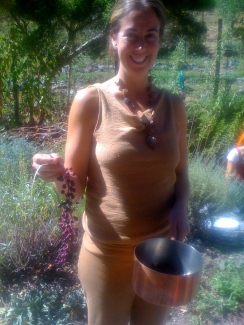
Poke root is a lymphatic cleanser… the fresh spring greens were canned for food sources (they must be well cooked so as not to be toxic)… and the color from the berries is almost too good to be true..
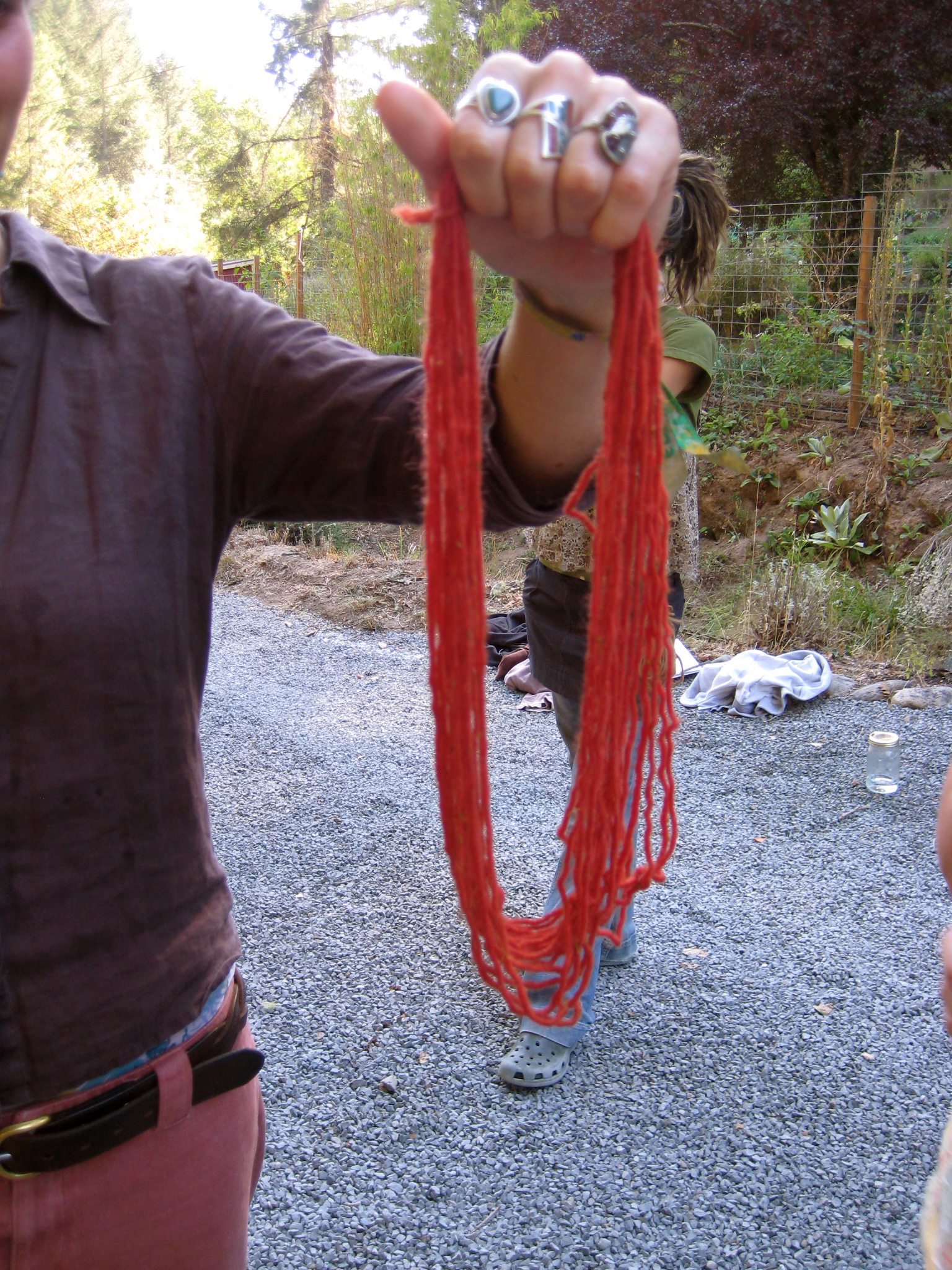
The Pokeberry took to the wool skeins the best…

Here is a beautiful silk sample done with coreopsis flower dye– (we made this dye during the workshop).

Another example of pokeberry and coreopsis, on wool– gorgeous!

This wool skein was dyed in coffeeberry and coreopsis.. half of the skein dyed at a time.

This rainbow effect was created with a light wash of pokeberry, sage, indigo, and coreopsis… some resist techniques were used.

Handwoven hemp samples–done in sage and madrone bark..

And here it is.. the most exciting new fall color– Madrone!! The bark falls to the ground this time of year, and produces the most beautiful chestnut brown.

The students explored the expansive medicinal and food garden for their plant pounding processes, all these materials were sourced in the moment, in midst of our workshop.

I think this cotton shopping bag of Sara Gottfried’s sums up this workshop best. The beauty of these colors.. the smells of wafting dyes, the innovative atmosphere, the offerings of the plants. Together these elements produced an experience like no other. It is the reason that I keep hauling dye vats long distances to these far destinations– the reason I spend so many hours preparing materials. It is a labor of love, a labor that gives as much as it takes. For me it is a way of life.

Thank you Roots students!
May the colors of the plants and the medicine they offer be with you always. The world needs what you are offering.
Gorgeous Green House Dye Workshop
September 19, 2010

Our first Regenerative Design Institute textile class was held yesterday, and what a day it was! Re-skilling is happening in our community one step at a time– practical DIY textile education is here! (Check out RDI’s classes)

The Pacific Coast was feeling pretty damp yesterday– so we went into the warm and lovely greenhouse to do our work, and keep from getting too wet.

We put the dry line outdoors– under some trees, it seemed to do the trick. The scarf that Dustin holds is an incredible testament to the late summer horsetail.

More horsetail in the foreground here, on lambswool– the soft pink color it produced was jaw-dropping!

It also proved to work beautifully on silk shibori pieces as well.. Rose is holding her horsetail scarf– a piece that she created with folding and tongue depressors.

Erin made this incredible indigo and california sagebrush piece with a pole wrapping technique.. a lovely outcome to say the least.

A beautiful and creatively dyed wool skein dipped in toyon, sage, on its way to another layer of color in the black walnut bath…

A series of wool strands dyed in all of our native colors (with the addition of indigo)…

A beautiful bowl of samples ready to be rinsed..
It was an honor to collaborate with participants whose life’s work spanned from the home-design-and-build sector– to organic farming.. we had an extremely talented and inspiring group who brought a new and unique flair to the ancient processes. I am so grateful for each and everyone’s participation– what a joy to explore the native colors with you!
Our next Natural Dye Workshop will be held on Oct. 3rd at Lambtown
Click here for the link and scroll down to for the natural dye class
La Belle Couleurs
September 6, 2010

Tannins, seeds of annatto, N’peku bark, and madder proved to have an almost infinite range of colors than I could have ever imagined– these totally unique processes were uncovered during my sojourn studying with a green chemist in the 10th century village just outside of Avignon, France.

I walked each morning through winding medieval lanes to the home and studio of Monsieur Garcia. A genius botanic chemist, committed to the innovation of natural dye processes for the industrial scale.

We worked long days in his lab– exploring what seemed to be a small fraction of the possible permutations that one could create with simple combinations of plant pigment, pH, and readily available minerals.

The options created with indigo applications were jaw-dropping… for me, who has been immersing in indigo, and creating indigo washes, for some time– it was incredible to learn how to make miniature vats of reduced indigo paint within minutes– without the use of any toxic materials or synthetically created reducing agents.

This is an example of the range and variation we created with the use of tannin. These greens, yellows, reds, and violets were brought to life with only two plant species.

We silk-screened masses of color variations on a locally produced wool fabric.

I spent many moments running up and down the 12th century staircase, moving between the application lab, and the larger machinery on the ground floor. All the while attempting to keep from knocking myself out on the very low beams that framed the house. I think people were much smaller back in the day this home was built… But what a gorgeous home it was!

This particular silk-screen has permanently changed my perception of what is possible with ellagic tannins… incredible.

The little village has a very small number of permanent residents– and yet, even within this tiny ancient city, there is a botanic garden– growing a collection of 300 dye species!
The plant colors, the ripening figs, the masses of sweet dangling grapes at every corner… the limestone architecture, all together has created an unforgettable sensorial combination.

Summer Creation
August 27, 2010

I spent the early afternoon across the Bay in the backyard of Dr. Sara Gottfried, to give her a dye garden consult and provide her with some materials for eco-painting exploration. She had some lovely organic cotton shopping bags ready for adornment. Her woad crop was looking incredible– and her sticky monkey flower was in full orange bloom. Since our last consult a year ago, she’s been busily cultivating her dye plants. Our meeting, this time, was focused on playing with new applications– particularly the use of natural dye paint…

Dr. Sara’s work is focused on helping women and men to live holistic and healthy lives.
It’s pretty well known that our everyday exposure to synthetic compounds has been creating some serious health impacts. Dr. Sara’s patients, which are everyday folks–show the signs, within their own bodies, of an environment that is pretty chalk full of things they cannot process healthfully. And for this reason she is committed to learning and incorporating natural and non-toxic ways of living into her own life–and inspiring others to do the same.
Natural dyes are one element, of a multi-thronged approach to shifting our personal practices towards the promotion of vitality– and health– for us, and the planet.

It is elderberry season– I brought this harvest to Dr. Sara’s house, so that she and her daughters could make an elderberry dye bath together. Elderberry on cotton creates lovely shades of lavender. We discussed the possibility of naturally dyed nurses robes.

Creating a healthier environment for ourselves, means resourcing and revitalizing our use of natural substances that we humans have had relationships with for eons.
Even good old cow manure, has a use beyond natural garden fertilizer. We mixed it with hot water, stirred, and made paint. We were certainly not the first to do this. The manure of herbivorous animals has been used as a mordant (binder), a paint, a dye, and fuel source for open fires, for as far back as records are available.
Community of Artisans
August 1, 2010

A group of artists and designers from the Fibershed project came together on a foggy Fairfax morning– that within hours became a gorgeous sun-filled afternoon. Designers Mali Mrozinski and Dyan Ashby prepare wool for combing on Katherine Jolda’s bicycle powered drum carder…
The Fibershed project continues to evolve and nurture a variety of our goals and visions for a cleaner and more community centered way of life. Most of us work rather independently within the world of textiles– it is a great alchemy and fusion when we can come together to learn, create, and share new skills.

Our teacher, Katherine Jolda– the owner and operator of Felt the Sun, designed and built her own bicycle powered drum carder to comb the wool and prepare it for felting. With a shortage of mills in the immediate area (minus the wonderful Yolo mill), many of us working with the material are in search of ways to process it in efficiently. The human powered carder can make a 5oz. batt of wool in just minutes!
Katherine spent 6 years on the Navajo reservation, working in a farm-based diabetes prevention program– and during this time built an intricate relationship with the churro sheep and the families that cared for them.

This pre-felted piece was all laid out and ready to felt just before this picture was taken. This piece makes use of both the churro and the by-product wool from Marin County.

Some finishing touches are being placed on what will become a kundalini mat in Amber Elandt’s Muir Beach home. Amber is a designer, and raw food chef that just finished an amazing hooded sweater design for the Fibershed wardrobe.

Sue Warhaftig is seen her working her wool into felt. Sue is a knitter, massage therapist, mother, gardener, canner, and picks up new skills very quickly.

As evidenced by this incredible fedora she completed in just one afternoon!

Molly de Vries the founder of the Fabric Society, and the designer of Furo Shiki fabric products completed a beautiful indigo dyed felted beret. It was just a bit too wet to put on the head.
Molly, her husband and three children have begun a project to live without the use of plastic packaging for a year, she has entitled it the non-disposable life. They are using the Furo Shiki fabric pieces to transport food from farmer’s markets to their Mill Valley home.

The bicycle powered drum carder in action.

Susan Hayes, the designer and owner of Point Reyes Station’s Susan Hayes Handwoven’s is seen here with the wooden mat, agitating the wool into it’s soon-to-be felted form.
 These are the talented hands of Erin O’Reilly of the Regenerative Design Institute in Bolinas, CA. Erin made a beautiful coffeeberry washed felted pouch.
In the process of coming together as a community, we became inspired by one another’s talents and enduring commitment to keeping these skills alive. Erin, like all of us, value these community experiences greatly; and yet, she has been taking her commitment a step further– by putting countless hours into organizing a series of re-skilling classes that will be offered by RDI this autumn (some of the textile classes will be offered as soon as this September).

Through the process of skill-sharing we are brought into a place of working, communicating, and enjoying one another’s company, in such a way that we not only enhance our own personal internal experience– but simultaneously we build a network of friendship, knowledge, and practical skill that simplify and bring ease and bounty to our lives.
The Young Ones
July 20, 2010

It was our final week at Ecological Arts camp this year. I worked with four and five year olds for five dayes of adobe, felting, natural dye painting, immersion dyeing, harvesting, silk paper making, and spinning. The two ladies in the above picture are sharing their prayer flags. They used one color at a time. Each paint symbolized a part of the ecosystem. We began with soil, we then added a layer of plants in the form of indigo wash, and finished the pieces with a layer provided by insects– cochineal beetles. Each member of the ecosystem contributing to the colors– overlapping, and intersecting through each child’s imaginative intention.

Ben is seen here admiring his adobe house, wearing his Toyon dyed recycled T-shirt and habatai silk scarf on his head. He became a Ninja, once he decided to wear his silk scarf around his forehead. Dicing the air with his hands and kicking at invisible attackers with his feet. He was quite entertaining.

Hannah was the youngest of our group. She dyed an old towel dress, and her silk scarf in Toyon. Her adobe house can be seen in the corner of the above picture– she called this her pancake house.

The Pancake house was a perfect home for a hand.

Some of these houses were perfect homes for little creatures– this one was made for insects and butterflies especially. Working with such young children is a pure joy. When we painted our prayer flags the children meditatively painted for an hour. One girl said, ‘this is the best day of camp I’ve ever had,’ as she carefully painted ochre onto her cotton flag.
It amazes me how simple the requirements are for facilitating joy. The children responded purely and with such focus to the use of these natural paints, not once did they request other colors– they peacefully and gratefully worked with the palate that nature provided.
Eco-Arts on the Bay
July 4, 2010

Two weeks of Eco-Arts classes just wrapped up… and I can say I am thoroughly content and exhausted from the experience. In one week we cover between five and seven ancient art forms whose modern applications have a strong potential to create a more sustainable material culture– adobe house building, wild paper, animal and plant fiber spinning, felting, weaving, and natural dyeing are all covered..

The children create their own adobe houses from clay, sand, and dirt… We gather, cut and measure willow frames, and make our own silk paper roofs.

The silk paper is made with raw fibers, and gathered objects that the children harvest from the site. We make sure to use materials sourced from the ground– or from invasive species for this particular project.

The houses are sometimes quite minimalist…

And others are more ornate.. In both cases, there is a strong attention paid to detail, and the houses always represent the aesthetic of the creator. Every child spends hours, and sometimes days composing their homes.

This year I was asked if they could add jellyfish to their adobe homes… I gently re-directed the beach gathering practice to sea glass, and rocks, which make much better furniture than do dead jellyfish.

These sisters were very proud of their sticky monkey dyed T-shirts and silk scarves, the hint of pink came from cochineal that was painted on as a final touch.

Milo made his T-shirt come alive with cochineal brush work, and a pounded pansy. His silk scarf was placed just-so– that he could be a ‘sushi chef.’ All of the Japanese shibori patterns, kumihomo braiding, and silk paper must have trickled into the children’s psyches, because by the end of the week, they were all pretending to be sushi chefs.
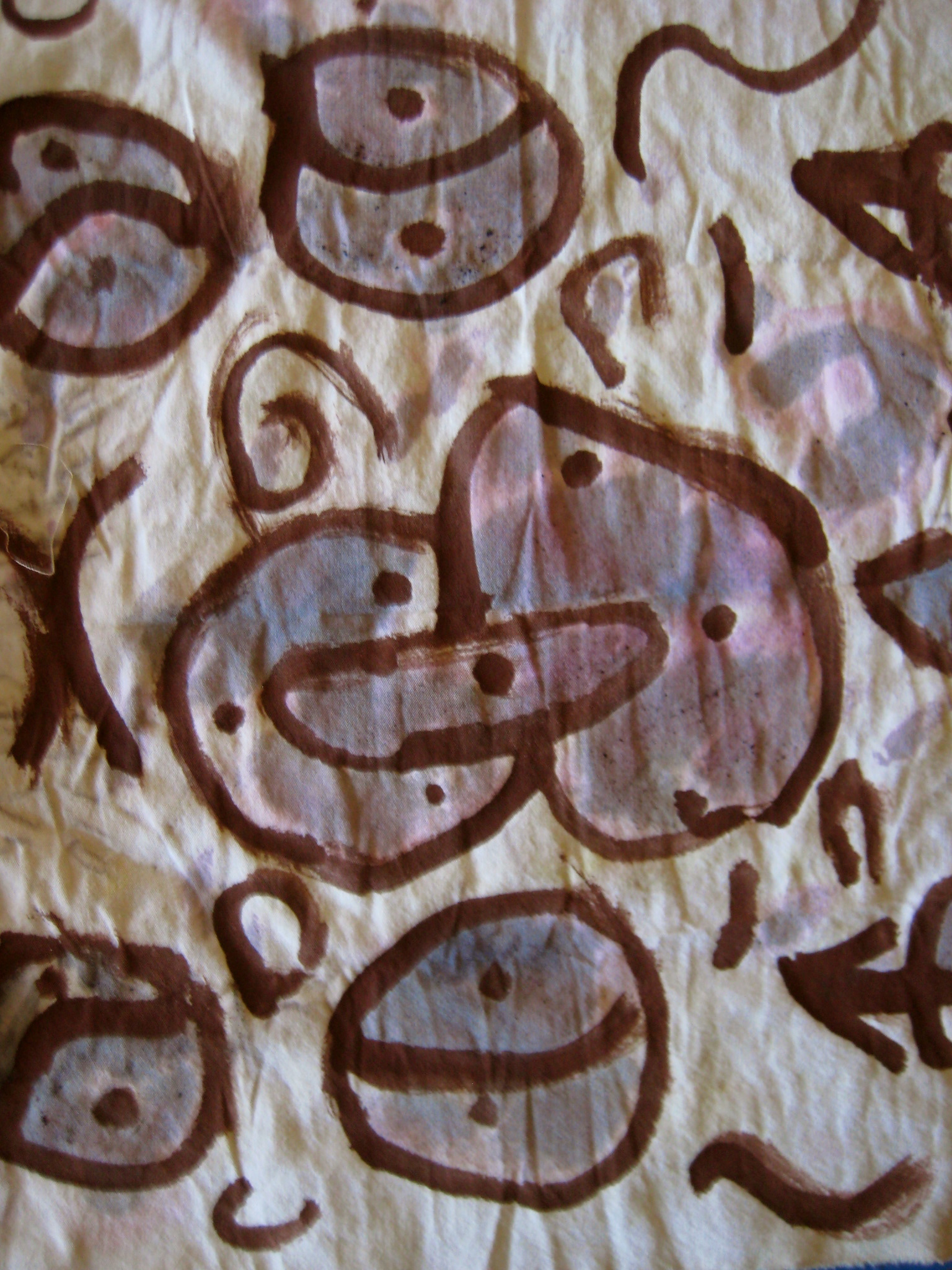
We also made paint from soymilk and clay.. This cotton fabric piece was painted with red dirt, and filled in with a cochineal wash.

By the end of the week, we were weaving medicine pouches with all of our naturally dyed wool yarns. Some of the children handspun their wool as well. I brought a spinning wheel in for them to begin to learn and understand the processes of fiber– and the technology surrounding it. Overall, a fabulous week was had by all– and as you can tell– a very excited, and sometimes silly group makes for a great learning community!
Heart’s Desire
June 22, 2010

Heart’s desire beach was the location of the 6th consecutive workshop that I led last week. I do apologize for the lack of posts. Summer becomes a busy time of teaching, planting, watering, and tending. In general the solstice brings so much more activity than any time of year– more light, means more time in the day to do things, and it seems there is so much to do…

I worked with Environmental Traveling Companions out at the State Park along Tomales Bay for a one day dye workshop. These young adults from Oakland, San Francisco, and Napa are selected to take a 24 day road trip throughout California, as a means to build leadership skills, get out into nature, and create community through peaceful and conscious communication.
 We used two of my favorite native species– Toyon and Sticky Monkey Flower. The toyon had been brewing since the winter months, and the Sticky Monkey was freshly harvested at a ranch in West Marin. The students went on a walk through the park with me to identify the native species that we were using for our vats. We discussed how the use of local resources can offset our need for foreign and synthetic substances. We also discussed how the practice of using these native species, done in conjunction with propagating them, enhances biodiversity, and awareness of indigenous habitat.
 Some students dipped their scarves in both vats for a two-toned effect.

Toyon with a creative use of shibori patterning.

Toyon and Sticky Monkey in the wind hanging on coffeeberry bushes..
 Students then used a combination of earth pigments and soy milk to make natural paints that they then used to paint onto their cotton squares. They are creating a collaborative quilt with messages about their experience on this long 24 day journey that they are now embarking upon with one another.

These were messages that the students quietly reflected upon, and then began to paint. These were their thoughts, and their mantras..

Toyon dyed cotton, with iron mud paint.

Done with a very fine bamboo brush…


The young people said it all. Not much to add to this body of wisdom.
Thank you ETC for such an incredible day– I wish you many happy and awe inspiring days on your journey.
Restoration Art Forms
June 9, 2010

The students at the Lagunitas School took part in an interdisciplinary process of ecological restoration, natural dye making, and weaving this year. To source our raw materials we ventured into the restoration site that exists just outside the student’s classroom. We planted, tended, dyed and wove…

This is a group of second and third grade students from the Waldorf Inpsired classroom. Their older brothers and sisters planted native plants over the last two years within an area of compacted soil, and poor drainage–with an intention to improve natural habitat for insects, amphibians, and birds. The restoration site is now cared for by the younger students who are able, due to the maturity of some of the species–harvest for natural dyes.
 We brought the dye pot out into the garden, and put our coyote brush trimmings right into the vat. The students asked the plant’s permission prior to taking any leaves or twigs. We likened our harvesting regime to giving the coyote brush a ‘hair-cut’.

After dyeing our yarns in coyote brush yellow, and toyon orange, we began the process of weaving our medicine pouches. Using a simple cardboard loom, and a unique warping style– the children wove in the round.

Up close, you can see the beautiful transition of the weaving moving from coffeeberry green, toyon orange, and coyote brush yellow. The weaving will be turned inside out once the woven pocket is removed from the cardboard frame. This way, all the loose ends will be on the inside of the piece.
 This curriculum is well designed for the activity and energy level of this age group. Whenever the handwork is done, students go outside to put elderberries in the ground! Good for them…. good for the ecosystem. I am always looking for mutually beneficial outcomes.. the mottos are ‘challenges are opportunities… find the best place for everyone’s skill… direct energy where it becomes most useful.’

It is quite beautiful to see what happens when human energy is focused on constructing healthy ecosystems, rather than destructing those systems. Although we were designing a restoration site initially to learn about native plants and ethnobotany…we soon realized that this restoration site, was creating outcomes far beyond our initial hopes. In the third year of planting, for the first time, a tree frog was found within the restoration garden. While there used to be many of these frogs in the area, most had disappeared. This frog was found right in the middle of a soap root and coffeeberry planting! It seems that this little restored zone has now become useful habitat.
We are in the process now of trying to understand how we did what we did– and attempt to keep doing it! We are adding more components to our curriculum as of this year.. and will continue to expand our knowledge of all the members (present and future) of this ecosystem, with the intent to continuously invite more species to our bio-diverse party.
Black Mesa Wool Buy Adventure
May 14, 2010

Ecologicalarts supports any and all projects that allow people to continue to live in balance with their land. When the opportunity came to share this event with the you all– I couldn’t resist. For the first time ever, a trip is being organized to the Black Mesa Weavers for Life and Land, during their annual wool buy, and you’re invited!

The Navajo Churro fleece is prized for its amazing colors- black and white, tans, charcoals, grays, silvers, reds and browns. The breed is listed as ‘threatened’ by the American Livestock Breeds Conservancy.

The life that the Navajo have honed with the Churro, has been cultivated on the land since the herds arrived to the continent in 1494. It is the oldest well-documented animal fiber tradition in North America.

The Wool Buy will take place this Spring from June 10th- 14th. Participants will have the opportunity to travel together to the reservation to purchase wool directly from the families who raise the sheep. The trip includes transportation, food, and 15 pounds of Navajo-Churro wool.

The trip is $450, $200 is tax deductible. Orders for fleeces at $20/lb are also being taken by those who would like to work with this incredible fiber but who can’t make the trip. For more information contact Katherine Jolda at (928) 221-4815.
Teacher Training at the Occidental Arts and Ecology Center
April 27, 2010

Teachers from around the Bay Area made their way to the far reaches of Occidental California for their first class in native plant natural dye work. The class included an extensive presentation on land-use philosophy and process, weaving developmentally appropriate story and props into the classroom, and most importantly–the use of dye vats!

The class was full of interesting stories- and personal histories. Many of the participants had created positions for themselves over the years as garden coordinators; feeling the draw to move out of the classroom and onto the land had motivated many to create and maintain school gardens. The natural dye work, and the native plants are a useful adjunct to any garden curricula. The hope is that all of our educational gardens will begin to illuminate not only food, but fiber, and color as well.

All of the teachers brought strips and samples of cotton fabric. I was teaching how you could do this in a school setting without high costs!

The toyon took well to the cotton. We mordanted the same day that we dyed, and our results were quite good. In schools- sometimes you’ll have the time to prep your materials, and sometimes it all might have to get done on the same day– seeing the mordant process is a great learning experience for the children and adults.

Great materials for plant pounding! Also a great activity for the pre-schoolers. The teachers who work with the little ones, were quite happy with this project. The use of rocks instead of mallets was discovered– another great way to make it accessible to many children at one time.

One of my absolute favorite native species–CA sagebrush, proved to be as lovely pounded, as it is in the dye vat. This was a great experiment, with incredible results.
Sangati Center Dye Workshop- May 16th
April 22, 2010

On May 16th from 10am to 2pm, the Sangati Center of San Francisco’s Mission District will be hosting a first ever Natural Dye Workshop. The center’s focus is to bring unamplified Indian Music to the community, and with 300 concerts a year– the center does an incredible job of bringing the music to the people.

The center is also a hub for traditional arts, and thus, what better a place could exist for a natural dye workshop? The rich Indian history of textiles includes an incredible series of natural dye recipes. We will honor our native landscape while taking inspiration from the Indian tradition with the use of indigo, as well as a peace silk that was raised, processed and woven in the Southern regions of India.

Native CA Toyon dye bath
Deepa Natarajan of the UC Berkeley Botanic Garden will be co-hosting this workshop. Deepa has been creating a native garden at the Center, a beautiful vision of what can be done in an urban landscape. We look forward to sharing this incredible day with you. You can contact Deepa to sign up for the class natarajan.dp@gmail.com
Fibershed in Person and On Radio
April 21, 2010

If you live in the area, you are invited to the Fibershed Fundraiser and Presentation, held in Piedmont, CA. Just RSVP before hand to Katherine @ 510 465-9439. It is a wonderful event, illuminating, educating, and accompanied by wonderful food and people.
If you would like to know more about the Fibershed– this new radio broadcast of the project, I highly recommend checking it out. Fibershed Radio Click Here.
Natural Color on the Creek
April 17, 2010
 The banks of the last central Californian Salmon run–a young man stands on the edge of the Lagunitas creek. He was accompanied by a group of 20 exquisite sixth graders. We spent a limited amount of time together– just a few hours, surprisingly it was plenty of time to shed the effects of the long car ride from the body, the squirmy response to bugs, and initial trepidation of moving from their urban homeland and onto the land. I asked the students as they were about to leave, what they would like to see on this site if they were to come back in ten years… a big question, but one they had no problem answering.
After this was taken the students spent a few final moments standing on logs, looking into the clear fresh water. This creek had a return of 66 salmon this year, and I’m grateful for those fish that made it. And yet, with a population that used to be thousands upon thousands strong– the situation does engender a mix of sadness and hope simultaneously.

Students show coffeeberry scarves in front of that very plant, that was recently placed into the new 'Rain-drop Dye Garden' at the SPAWN gounds
As more young people are given opportunities to get into the ecosystem, and process it through the sensory experiences provided through the visual, auditory, tactile, and kinesthetic systems– the more the land is embedded into their awareness–an unforgettable collage of native plant colors, warm mud, draping arroyo willow branches, and the promise of salmon is created and woven in memory and will inspire untold and infinite small actions.

Preparing for the toyon and coffeeberry dye vats


Dye Day at Berkeley Botanic Garden
March 31, 2010

The temperature was perfect, the sun just right, sweet smelling toyon, coffeeberry, and coyote brush dye vats wafted into the afternoon air. The thick smell of black walnuts (which have been soaking since last fall), did overpower the senses a bit– an aroma that crosses somewhere between old seaweed, and a compost pile. It is actually a nice smell– very earthy, just a bit pungent.

Deepa Natarajan the Berkeley Botanical Garden education coordinator with Susan Kuehn the coordinator for the San Francisco Garden for the Environment
The group of 17 women coalesced creatively amongst the native plant colors– and the blues of the fermenting indigo vat. The participants level of expertise within this field spanned from commercial textile designers–natural paint makers–scientific illustrators–to professional felters. I was so inspired, and grateful for the advanced level of awareness that was brought to this workshop. We could have spent at least two days simply networking and weaving our skill base together, to bring forth a natural color and fiber revolution.
 A handwoven hemp– roughly retted and then woven on back strap looms by the Karen women of North Western Thailand, dyed in our native toyon dye bath.
 A beautiful example of Indigo on silk– with the use of a bundling shibori resist technique.
 Black walnut browns over dyed with fermented indigo.
 A blend of many dips in many baths- including eucalyptus, indigo, and possibly one other species…
 A well organized compilation of samples– raw hemp, organic cotton, and blends of both fibers, dyed in the native species, as well as eucalyptus.

Samples were a challenge to extract, with so many floating and submerged within the pots. There are always a few little pieces that show up at the end of the day, as I’m cleaning and re-pouring the dyes.

Thank you Berkeley.. The biological diversity of the garden was deeply reflected in the diversity of talent, capacity for understanding, and depth of interest of all those who came. I enjoyed myself so much- and am excited for our future collaborations.
Starting to Grow More Color…
March 26, 2010

Bolinas is a town set within in our Northern California coastal region that could never be summed up by one person, in one blog. Yet, if I were to attempt to share with you the magic of this place I’d start with the mind blowing trails that hug the coast, and lead to among many things.. a clothing optional swimming lake that rests just above the Pacific Ocean. It includes a human community of artists, poets, musicians, organic farmers, nationally renown gardeners, permaculturalists, thinkers, and philosophers, (and again these descriptions just skim the surface.) This is also a community that was well-known in my childhood for taking out any and all sign posts leading to it. The quieter, the better was the philosophy, and still is. This entry, I realize is a virtual sign-post for a town that desires no publicity- and so I apologize in advance for any extra attention that may come its way. However, exciting things are brewing in this gorgeous place. Wild and cultivated dye colors are being discussed, and planned.

From the back of the farm the expansive view of the Pacific Ocean
The Regenerative Design Institute is a nonprofit educational organization with the vision that all people can live in a mutually enhancing relationship with the earth. They’ve been teaching and practicing the ‘way’ for some time now. Their farm currently supplies their partner organization the Commonweal institute with clean, organic produce for those individuals recovering and surviving cancer.

European variety blue elderberry- great dye making species
The Regenerative Design Institute will be the site of a new breed of textile classes in the near future. A place where cultivated species as well as tended natives will be used on an ongoing basis for color creation. It will be a place for serious study and practice of this art form. My visit to the gardens and surrounding wild lands imbued me with a feeling of complete serenity as well as delight– that yes, there will soon be the opportunity to chart and directly measure the effects of sustainable wild-lands harvesting.

For those coming to Berkeley this weekend, you’ll get a taste of the first harvest of the Bolinas horsetail. The Regenerative Design Institute site is currently full with this 380 million year old species. The early spring shoots are showing promise of a very soft pinkish tan, (as far as I can tell from the sweet smelling dye vat that boils away downstairs). My experience of harvesting the shoots in the late spring has been that the color deepens as the soil dries out.

last year's late spring rose from horsetail-- on a Point Reyes wool
Of all the many native plants that we will have the opportunity to work with– horsetail is one of the unique color options that cannot be replicated by any other species that I’ve worked with. Some come close, but none quite match this lovely soft shade of rose.
Ecologicalarts Launches The Fibershed Project
March 17, 2010

Paige Green Photography: Shugri is wearing a Point Reyes wool handspun hooded scarf dyed in madder root.
Its been gently rumbling throughout this blog, the message of fibershed has rippled out here and there. However, its now a done deal! On Saturday March 13th, a team of artisans came together, over fresh local oysters, and Napa Valley biodynamic wines, and launched the project, amongst a receptive and supportive audience of family and friends.
The goal is to create a wardrobe that I wear from fibers and dye plants sourced within a 150 mile radius of my front door.
Why we’re doing it: I’ve written a bit about the textile industry in this blog before– and most of the readers who come to this site, are here to learn about alternative color sources. Even so, many people are unaware that the textile industry is the #1 contaminator of fresh water resources in the world– there are an average of 2,000 synthetic chemicals used to treat our garments–these chemicals are known to create anywhere from irritating to fatal effects in humans. And, if that wasn’t enough–even though the United States has moved most of its industry off-shore, textiles create the 5th largest carbon footprint of any industry in the nation.
[For more facts on the industry see O ecotextiles]
My response to this litany of unappealing facts has been brewing for many years, and since the recent economic debacle that has many communities facing a financial tail-spin–I felt it might be time for some investigation into how we could turn our fashion industry into one that worked hand-in-hand with organic regional agriculture, local economies, and principles of sustainability.
Fibershed is designed to be a module that gathers information about the possibilities, opportunities and challenges of creating bioregional clothing–and then share these stories with you. With the hope that both artisan scale and commercial production textile ventures will begin to harness the opportunities of creating and honing a stronger local component within their product lines.
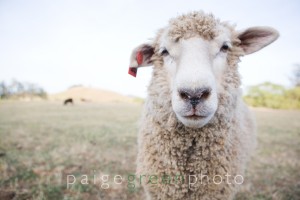
Paige Green Photo: One of the local Chileno Valley Sheep. This lady is likely the CMV breed
Our Fibershed team consists of Paige Green who will be documenting the farmers, herds, and wildlands where our raw materials for the wardrobe will be sourced. Our film team Melissa Mansfield and Averan Gale will be creating a video documentary of our story. Heidi Iverson is the knit wear designer, pattern drafter, and all-around style sensible artisan. We also have a number of knitters and spinners from around the Bay Area who are bringing their talents to the project. If you’d like to get involved as a collaborating artisan, feel free to contact me.
To learn more about the project you can click on the image below, and go to our grassroots kickstarter campaign. We are using an innovative new community based model of gathering pledges– We are a non-profit– but not a 501-c3. We decided to do this because we are focused on being a one-year, ‘project-based’ team. All the money that comes in, goes directly into the community of farmers, artisans, photographer, and film makers.
I and all the team members look forward to bringing you the most beautiful, jaw-dropping pictures, well written stories, and captivating films. So if you’ve been happy with this blog so far– imagine it getting even more interactive, more beautiful, and more frequently written in! If you’d like to see that happen–make a pledge and spend a few moments thinking about all the others in your community of friends and family who would like this project, and then forward them the message. We are the ones that make this happen!!
thank you….
Permaculture Marin Natural Dye Day
March 8, 2010

The first annual Permaculture Marin dye workshop was as pleasant a day as could be imagined. The clouds parted, the blossoming fruit trees stood above dense carpets of multiple shades of green, and the people gathered.

An intersection of passion, prior experience, and curiosity brought together a group of men and women with a broad background of weaving, teaching, gardening, farming, and spinning experience. We created a laboratory of creative color — using toyon, indigo, black walnut, fennel, french broom, coffeeberry, iron, and tannin.

The indigo vat was slow to ferment the day before the workshop–too cold for the yeast. The sun came out for just enough time to coax it into producing some very lovely blues.

This workshop took place at one of the most beautiful of gardens. Originally planted, designed and cared for by teacher, farmer, and weaver Penny Livingston of the Regenerative Design Institute in Bolinas. The land is now tended and cared for by Lauren, Dave and Molly– all teachers, and gardeners extraordinaire. The strawbale structures, the gray water systems, the orchards, and the silver dollar eucalyptus planted for its dye properties are just some of the many elements of this amazing homestead.

The colors of the day

The dye pots getting introduced to the people.

The creations were mesmerizing– the colors soft but striking.


Thank you Permaculture Marin for your work! I am so grateful for all you did to make this day happen. Beginning months before we set foot in the garden, until the day of… The coordination of all the details in addition to the worlds greatest lunch, together made for a beautiful experience, now indelibly placed within the memory of all good things.
A New Color Aesthetic
February 21, 2010

Ingredients List = This is the native coffeeberry sweater; all the greens were produced from one plant, cooked under a variety of heat and timing conditions within a copper pot. The collection of yarn is all naturally dyed. The wool was handspun from Windrush farm’s flock of corriedale cross, shetland, and CVM sheep breeds.
The beauty of using a native species such as coffeeberry for color, is beyond the zero carbon footprint– it is the relationship with the species that changes you forever. Whether I’m walking on the trails, down the road, or in the car driving through the rural valleys– I can spot coffeeberry where ever I go. The plant has become an integral part of how I view my surroundings.
With so many amazing colors that we can derive from botanical sources, and with the unending benefits we receive as we become apart of our local ecosystem– I simply wonder why we still bother with toxic synthetic chemicals..

Short Answer: Cost. Of course. The other more complex answer to this question is one of human patterning– once a society builds mental relationships with cost, color, and convenience, it is not easy or simple to alter human belief systems about what is and isn’t possible. This is why I appreciate the message from visionary activist Caroline Casey- Don’t believe anything, just keep entertaining possibilities!

I like the above possibility very much. A natural dye studio I visited in Bali, surrounded by the Indigo plants used to make the beautiful blue colors. The synthetic dye studio, with its untreated chemical waste pond, is unfortunately a more common scene within the Southeast Asian textile industry.
If you’d like to support naturally dyed textiles, I highly recommend the work of Tinctoria.
If you are looking for a naturally dyed shoe I cannot recommend enough the work of El Naturalista.
Winter Madder
January 23, 2010

With winter rains pouring, creeks bristling almost over capacity, lightening striking Redwood trees… This has been a wonderful week of weather. And due to the predominant quiet gray light, it felt appropriate to pull out the dried madder roots and prepare a dye vat whose colors would inevitably warm the heart and soul.

Madder has rhizomatous roots, and spreads effortlessly across most landscapes. I’ve seen it growing in Wyoming, all through California, and have heard reports of it successfully being cultivated in the central and Northeastern states. Its brilliant orange/red color releases into the dye vat within a couple of hours of gentle heat. This dye lot turned a shade more orange than my other winter vats, which have been predominantly quite red.

I recommend the book, The Wild Root of Madder for your natural dye literary collection. It surveys the history, and lore of madder’s use within Persia. The traditional madder root dyer’s were well regarded artisans.. During the dissemination of synthetic dyes in the late 19th and early 20th century, the Iranian government banned there use– in an effort to to protect the natural dyes, and the craftspeople who used them.

Madder’s deep orange-red is a familiar color often seen in butterfly wings, berries, mushrooms, and autumn leaves.

Dyeing and Middle School
January 15, 2010

When the middle school group found out we’d be dyeing, the jokes began… ‘I’m too young to go’, ‘We are dying.. at school?’. I presented my powerpoint on natural dyes for them, and they were extremely animated as we poured through pictures of coal tar processing plants and synthetic dye houses, and then made comparisons to the natural dye studios and the dye crops. The questions began rolling in, ‘Can we dye black’, ‘I’d like to dye the Mexican flag, how do I do that?’, ‘Can you show me how to make purple?’

Then we discussed the native plant connection, and that the colors we’d be making were from native species. They had just learned about native and invasive species in science class earlier that day. I had prepared two of my favorite winter native species, toyon and coffeeberry for them.

I showed them how to create a shibori patterns on their silk scarves. As they tied rocks, sticks, and rubber bands to their pieces they became completely engaged with the creative process, and particularly interested in developing pattern. The patterns and shapes reminded them of certain body parts, and this kept them all very entertained. Once they began removing things from the dye vat, they were transfixed. ‘This is awesome!’, ‘Do I get to keep this?’

This particular piece was a complete experiment in pattern. I have never seen anything quite like it.

As the sun began to set behind the San Rafael hills, the questions came like a lovely refrain, ‘When are you coming again?’,
‘Next time bring blue’, and ‘Can we do a whole day?’
My response, ‘I would love to- and yes, I’ll bring blue’
Thank you North Bay Conservation Core for inviting me to work with this wonderful and well-humored group of young people. If anyone lives in the Bay Area and would like to attend an incredible community event- I suggest going to the community and school garden building day at Martin Luther King Middle School in Marin City on January 18th. I believe Carlos Santana will be performing, and food and drink is available for volunteers. Check out the Conservation Core website for more info!
Winter Windrush Photoshoot
January 9, 2010

Today was a day of taking stock. Many photoshoots have been done to prepare images over the last year. Today’s goal was to fill in the gaps, to create a fully comprehensive collection of images for the work we are creating on natural color.

Taking a few moments to catch some shots of my own. The quiet of my winter garden has given me the opportunity to work with ancient dye stuffs that I only rarely use. This collection of cochineal is a reminder of why exploring Spaniards gawked when they first saw this rich Aztec dye.

They loaded thousands of pounds of the material onto their ships and sailed home to show Europe the ‘new crimson.’ I can’t imagine the look in the eyes of the people as they cast them for the first time upon the newly dyed cochineal robes.

My cochineal would have no canvas if it were not for these lovely sheep, the corriedale cross herd of Windrush farm is seen here in their great winter coats. Spending a day in the midst of these gentle animals is the most calming of any experience I could dream up for myself.

And the oh-so-soft-alpaca, staying warm in her fine coat, enjoying the winter light as it exits behind the ridge…

And then, it was time to go.. we packed the car with massive amounts of dye equipment, and off we went.

Arlo and Paige in the front seat. He is a patient dog, and a perfect match for a wonderful photographer such as she. He sat and quietly watched the photoshoot for hours, occasionally chewing on a madrone wood stick, or eating a stray acorn.

The drive home. The expanse of fog, light, grass; these are the surroundings that gently seat me in the wisdom of place, and inspire the subtle and engaging colors of my dye vats. These are the landscapes I will be exploring and taking inspiration from for the rest of my days.
Family Fibershed
December 30, 2009

This holiday season our family received gifts of 100% locally raised fiber. Prototypes for my fibershed project are emerging, and the visual flavor of these pieces are as divine as a Napa Valley Chardonnay or a Cowgirl Creamery round of Mt. Tam cheese. My mom is wearing a delicately soft handspun and handknit angora (rabbit) and merino (sheep) scarf that I made. I sourced the raw materials from Mendocino fibers; Jean Gowan of Utopia Farm, and Charlie, of ‘Tall Charlie’s Angoras’ kindly raised the animals.
The making of this scarf provided yet another opportunity for connecting more deeply with the coastal California landscape. I am a fifth generation Marin resident, who still lives in the watershed I grew up in as a child. We’ve always loved where we live– and found every possible way of celebrating the bounty of the land we call home.

Great Grandmother paddling on the Corte Madera Creek
My great-grandmother and her family built tent cabins along the creek, they spent their summers enjoying the sun and warmth along the edge of the water. A concept like ‘fibershed’ would have likely baffled them– there was no ‘ecological footprint’, carbon calculations, or global economy of scale in place to define their reality. Local food and fiber were norms, not exceptions.
 My brother is wearing a hat I made from Chileno Valley wool in brown, gray, and black; all handspun and plied to create varying color combinations. My brother is the photographer who refurbished the photo of my great-grandmother, and did a fabulous job taking shots of both my mom, and myself.

Here is my prized holiday garment– 100% Chileno Valley wool, that I handspun and dyed in native coffeeberry branches and twigs. When I put this sweater on, I feel as though I am truly wearing a second skin.

The relationship web created by the making of these pieces is intricate and transparent. The sun, water, and air of West Marin produce grass for grazing sheep, who in turn grow this wool– I befriend the ranchers– I buy their wool– I spin it– I grow and harvest dye plants to dye my wool– my neighbor knits– the resources remain local. Smiles emerge at every level of exchange- each transaction becomes a story, a part of a way of life.
Every Drop Counts Restoration Dye Garden
December 20, 2009

Saturday morning in West Marin–in between the Redwoods of Samual P. Taylor Park and the National Seashore, a small group of young and old met to create the ‘Every Drop Counts’ restoration dye garden. Shaped like a raindrop or a tear, the garden greets those who drive into the SPAWN grounds and offices, and will function as a demonstration for how to slow- spread- and sink rain water that flushes into the Lagunitas creek. The creek currently hosts the last remaining endangered coho salmon run in central California.

All efforts are being made to mitigate erosion, and build habitat along this creek. So far this year 60 spawning salmon have been counted– the numbers are up from last year (a year we thought they may not have made it). This rain garden was filled with coyote brush, coffeeberry, stickymonkey flower, yerba buena and buckeye– all of these species will build healthy and deep root systems, promoting the permeability of the soil. This will in turn slow the water’s movement into the creek, reducing erosion, and the risk of flushing the young salmon fry out to sea. The co-benefits of saving salmon, healing soil, and creating bird habitat– is the ability to make natural ecological color.

This is coffeeberry dye on a Point Reyes handspun wool, it is just about to be incorporated into a ‘coffeeberry sweater’.

A young coffeeberry just planted into the garden yesterday, it will take some time before it requires any pruning.

A buckeye being well cared for by two volunteers. Our planting was done by the hands and hearts of a group of young women, many of them came with with the support and help of Environmental Travelling Companions. A non-profit leading trips in sea kayaking, white water rafting, and cross country skiing, for a diverse socio-economic, and range-of-ability cross-section of folks. Their youth leaders came to do the planting– all of them hearing about ecological color for the first time. A follow-up natural dye class is in the works.
What a day… Young women leaders working to restore lands, hearing visions for a future filled with environmental action and art… a male salmon swimming upstream… there is so much hope and passion that grows from the sharing of a common cause.
Toyon Cowl
December 12, 2009


Early morning Saturday expressions caught while wearing the toyon neck cowl. I just finished the piece last night, after starting it during the last phase of our dye class last week.
I used Heidi Iverson’s cowl pattern, and borrowed her incredible circular needles (connected by a tube instead of a plastic string).
I handspun the yarn from Mimi Luebberman’s corriedale cross, West Marin roving– and dyed them in a month old Toyon bath. This cowl is sooo warm, I feel like my overall body temperature has been raised. My hands and toes are warm too!
After my afternoon swim– I relish the thought of slipping this cowl around my neck. Life has improved with this little accessory!
Winter Dyes
December 7, 2009

The morning began with a 1/2 inch layer of frost on the kale leaves. The cold was welcome, as it seemed to keep the rain at bay for a couple of days so we could complete our dye work. We began by preparing alum and tannin baths, followed by a long hike into the watershed to look at coffeeberry and toyon in the wild, and then returned to the dye studio to prepare pre-cut branches that were gathered the day before. Students worked to light fires of the rocket stoves—these are a wonderfully efficient heat source, that bring water to a rapid boil.

The second day we worked with Toyon and Coffeeberry vats we had prepared the day before, as well as older vats of the same species that had been curing for weeks before the class began. The above vat is an aged toyon that provided lovely orange/rust colors.

This was the fresh coffeeberry vat–made in a copper pot which created variations of yellow and bright khaki greens.

The second day ended with a beautiful array of colors–that came from two beautiful winter harvest species, no modifiers, and only an alum mordant. The dyes are shown on a superwash merino sock yarn, and a DK weight merino yarn.

Cotton flour sacks were first mordanted in tannin, and then alum. This pre-mordant combination created strong colors on the cellulose fiber– akin to the colors created on the wool.

Aged toyon, a fresh toyon dye, and a brief dip in the new and old coffeeberry vats are reflected beautifully in these handspun yarns. The color of our yarns were observed to be the exact shades of the turning maples that framed the garden– yellow-green-and orange.

The third day began with some wonderful knitting instruction, that included a little history along with very clear technical support from Heidi Iverson. Ball winding was the first order of business, followed by instruction in how to work with circular knitting needles- we cast on, and the knitting began. More pictures of our winter cowls to come– as they are completed.

The final joy of the workshop was had when our maple prints were unfolded. After a long dip in the tannins, and an overnight soak in iron—this completely amazing print was unravelled.

Another close-up of the flour sack– turned fine art. Overall, a wonderful three day dye experience was had.. A time of gathering– for both plant and human, and a time of color.
Local Mordant
November 28, 2009

With acorns raining on the rooftops–I felt inspired to see how I could put this abundant resource to use in the dye process. Tan oak bark and shavings have long been known for their role in tanning hides, they were harvested almost to the point of complete decimation in our area. My intention was to use the renewable part of the tree–the acorn, and make the most of the acorn meat in the process. Tannin is a non-metallic mordant- and the only mordant that I have found locally available. It can also be used as a dye–creating shades of light brown when used on its own.
 After pounding the acorns with a rock and peeling them, I added them to a food processor to blend them into smaller chunks. The chunks were placed in a cloth bag. I let the faucet water drain through them. I squeezed the bag occasionally to see thick brown water leaching from the acorn meal. The tannic acid comes out of the acorn in the form of a thick starchy like substance. At one point after several hours of leaching, the acorns were done- and the water ran clear. I dehydrated the meal- and saved that for a future batch of acorn cookies.

I had also experimented some time ago with making a mordant from rusty objects– by soaking them in water and vinegar. Tannins and iron produce lovely shades of gray.

Paige Green Photography
After creating the tannin and rust waters, I put a strip of hemp/cotton fabric into the tannins for a day. I then rolled up the wet tannin mordanted fabric with several maple leaves and put it into the rust water, after a day and a half I unravelled it.

The finished fabric is gray/blue color, and the maple leaf prints turned a very light green. The joy of making a mordant out of a wild food by-product was such a wonderful revelation. I will continue with acorn tannin experiments to see the effects on wool with native plant dye colors. I’ll keep you posted!

Farming Color
November 22, 2009

A yellow cosmos from the Urban Eagle Herb farm in Youngsville New Mexico
The first yarns that I ever dipped into dye baths, were immersed in madder root, weld, and Indigo—India, Central America and Europe were the landscapes of origin for my dye stuffs. So much importing for a natural dye seemed paradoxical. I read, I researched, and eventually, over the years I figured out new ways of localizing my process. I grow many of my own colors now, and am always looking for a more local source when I do need to purchase a dye stuff. I was so excited when I discovered Katy Blanchard, and her natural dye and herb farm– Urban Eagle Herb Co., in Youngsville, New Mexico.

Madder Root at the Urban Eagle Farm can yield strong reds
Blanchard was apart of a collaborative project between New Mexico State University, Becky Thorp of Sunstar Herb Farm, and Luz Hernandez of Las Cruces. In 2006 the project was awarded a Western SARE grant to explore the viability of raising dye crops. They were required to grow cota, Hopi dye sunflower, tansy and weld, plus four other species of their own choice for the particular growing conditions of their area. Blanchard introduced madder–other plants being grown included woad, coreopsis, cosmos, yellow yarrow, holly hocks, black-eyed Susans, safflower, marigold, alkanet and Mexican sunflower. Blanchard’s excitement for this project was in part due to her knowledge of the overlapping uses of many of these species–cota for instance is known as Navajo tea (on the Navajo reservation), and is a wonderful digestive aid, and immune system tonic, as well as creating a brilliant yellow and sometimes orange in the dye vat.

Tansy at Urban Eagle Farm- yields yellows
If you go to Blanchard’s Urban Eagle Herb Farm Website, you can see more pictures of the farm, and the list of available dye materials. Currently listed dye stuffs are, cota, coreopsis, cosmos, tansy, and madder root. This year Blanchard sold out of many of her dyes already, so email her directly at info@urbaneagle.com to see what she has available. She also sells her dyes at the Espanola Valley Fiber Arts Center, in Espanola, New Mexico

Cota at Urban Eagle Farm
I am grateful to Katy Blanchard’s pioneering spirit– and that she is able to offer both her local and greater Western United States community some wonderful home grown dye stuffs. I hope to see more kindred-dye-growing souls like her in the future. All these lovely pictures were taken by Blanchard, among her many talents she is also an experienced weaver and knitter.

Mullen- common species that can yield soft greens
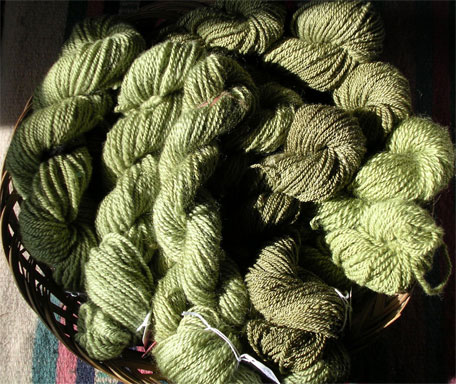
Blanchard's mullen dyed skeins
Footprint of a Fiber
November 12, 2009
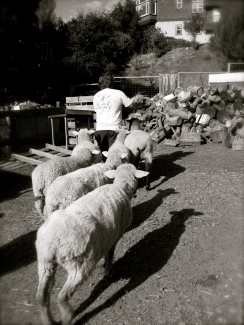
It was not long ago, just in my parent’s own childhood when chronicling the carbon footprint of an item of clothing might not have taken very long. A cotton farm in Texas, a sheep ranch in Wyoming–these raw materials would have been sent to any number of mills across the country and then been sold at working class stores such Wards and Sears–this small production cycle was not a design concept from a sustainability think-tank, it was simply the way things were done. With very little discussion or fanfare this supply chain underwent a radical transition. In 1965, 95% of America’s clothing was made in America, and today less than 5% of our clothing is made here. Along with the export of farming, milling, and sewing- so went jobs- environmental regulations, and in many cases quality. Some of the more enlightened transnational clothing companies are in the process of cleaning up their supply chain and are looking deeply into the above issues. However, this still leaves us with a question of carbon footprint, and might I say jobs?
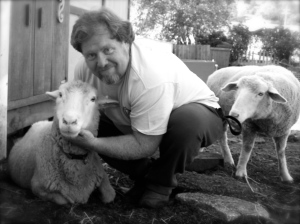
Our carbon footprint is most simply reduced by making use of what is local. This is Kenny, an all around sustainability expert, who feeds the grid daily with his solar panels, watches the neighbors deposit their compost for his chickens, and collects oil from local restaurants for his veggie-oil Volkswagon. He raises food for himself, and shares his garden with others in the community. Our lives intersected, when I found out from a friend that he was raising sheep just around the corner from my town, in Mill Valley of all places– 10 minutes from the Golden Gate Bridge. Kenny’s farm has been in the family since 1867 the old house is still lived in by his mother. Kenny primarily harvests meat from his flock, however, being an open-minded man of many trades–he wants to make the most of the wool that he shears.

At the moment, the process of turning Kenny’s wool into a hat, sweater, or pair of gloves– is still around the corner. What we have established is a relationship. And that, is the cornerstone of the localization process. As we seek out resources within our towns and cities we meet people, we hear their stories, and become increasingly more in synch with our modern village. This community building is one of many benefits of doing good for our planet. I’m just now on the path to turn the above fleece into something a bit more palatable for my local textile creation project.

This is an example of a roving ball–just ripe for spinning. This lovely wool is from a rancher living 20 miles from my home (just over double the distance I travel to Kenny’s suburban farm). I will send Kenny’s wool off to a mill for processing, if all goes well, it will return to me as a very spin-able ball of roving like the one pictured above.
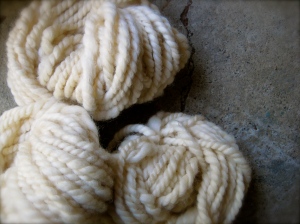
From this ball of roving, I will spin away on my little wheel, and create skeins of ready to dye yarn. Once the yarn is spun I will partake in the process that I often highlight in this blog- the creation of local natural color. If all goes according to plan, I will become one step closer to my local clothing vision. I’m estimating the CO2 footprint of my finished yarn, and knit clothing will net far beneath the weight of the yarn itself.
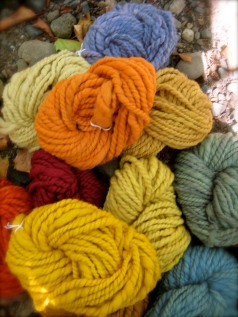
Handspun Yarns dyed in summer blooming plants
This is a huge reduction in carbon, if compared to even the best case scenario for industrially produced clothing. Patagonia- my favorite and most transparent clothing company has recently created the Carbon Chronicles. If you click on the link, you’ll see that their wool merino undershirt produces 47 pounds of carbon before it even gets to your door. That is just one shirt! And yet, I applaud Patagonia for their ongoing commitment to preserving the earth’s last wild places– they are a fabulous company with a wonderful mission. It’s going to take more than a village to clean up textile production– and in my personal and small way I’m committed to doing so, one ball of yarn at a time.
Time for Toyon
November 8, 2009

Toyon is a year-round favorite at dye workshops, yet it is truly the fall and winter prunings that make the strongest vats. This tall shrub produces bright red berries at this time of year, that last well into the late winter. They are hard, loved by birds, and with some roasting can be eaten by humans too. The plant appears to have more pigment within its stems in the colder months. Pruning back the suckers, and gangly stems is one method of collecting for the dye pot, without taking the berries (these aren’t needed to make dye.)
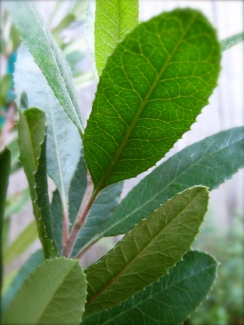
Here is the plants hearty autumn leaves, and if you look closely you can see the red pigment that is traveling up through the stems and through veins. This pigment is what yields these rusty orange tones on the wool.
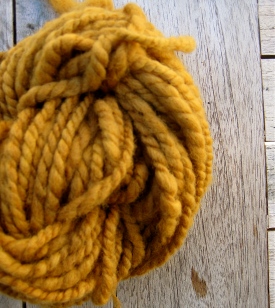
This color was produced in a stainless steel vat, and is perfect for the season. It would make a lovely neck cowl, or cozy hat. The longer the leaves and stems soak for, the stronger the color seems to be. Because of the heartiness of many of the native species, it requires time, and some periodic heat to release the desired color. Without this long processing time, Toyon produces a range of yellows.
Coffeeberry & Copper
October 30, 2009
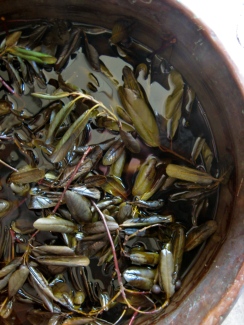
Coffeeberry is a late autumn and winter bloomer, providing food for the birds, and dye material for the natural dye vat. Without the presence of copper, Coffeeberry produces a very pale yellow. Yet, there was something about the quality of the yellow that did inspire me– and I felt that with the influence of a copper vessel, I could easily green the tone. I experimented with this several years ago in a borrowed pot- and was very pleased with the results.

An old farm sale out in the Valley last weekend provided me with these two exquisite copper pots. In some ways I am still in awe of this find, I’ve been waiting many years to source just the right copper pot, at just the right price– and voila– it finally arrived into my life.
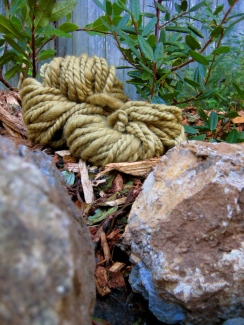
Here is a picture of the skeins amongst my little coffeeberry plant. It has grown in the shadiest part of the garden with success. I have four coffeeberry plants in the native garden, they will likely reach 10-12 feet if I allow them to grow that height. I can keep them small and shrub like, by pruning for my dye vat.
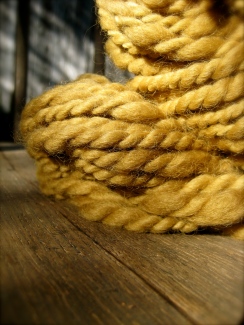
The handspun corriedale cross yarn comes across vibrantly in the morning sun. In true life color– they are much greener than this.
Viable Indigo
October 27, 2009
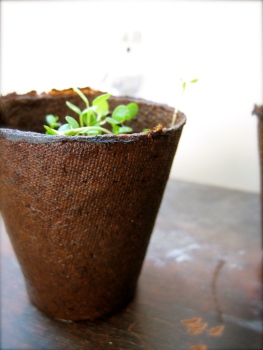
I’ve sent out and distributed to at least 30 seed packets to a range of those interested in starting their own dye gardens. One pertinent question came in from a reader in New York- regarding seed viability. She had experienced many unsuccessful Indigo seed germinating trials. I realized it would be a good idea to do a more in depth viability study on my seed, so that I could be very clear with people about what I was sending them! One other important bit to understand in relation to germination of this seed, is that you must use it when it is fresh- within the year that you receive it is best.
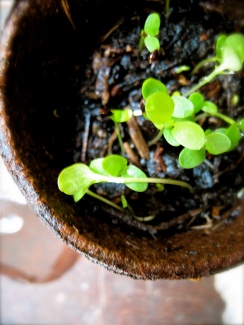
The good news- that I am so happy to share, is that after taking samples of seed from a range of the plants (both pink and white flowering), and testing in them in various conditions (under a heat lamp + seed heat mat, as well as using the kitchen window sill), the seed germinated with approximately 90% viability. If you received seed– keep it in your refrigerator until it is planting time (this is regionally specific). In my area I plant my annuals indoors in the late winter, and early spring for a summer harvest.
I received the most lovely cards, letters, handmade paper, and envelopes from some of the seed buyers– I must thank you all for the creativity and beauty that you shared with me. I will keep them forever, as a testament to the beginning of this journey I have begun as a harvester and disperser. The other wonderful news, is that there is so much more than I expected. My plants went into real production mode this last summer, and I have enough seed it seems to dye the entirety of my neighborhood’s clothing blue. If you would like seed-there is more!
Native Seed
October 23, 2009
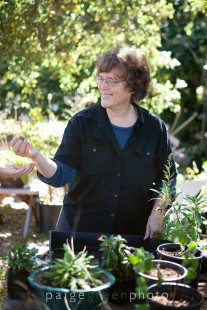
Judith Larner Lowry: Paige Green Photography
I took a visit to the source of my emerging home dye garden– Larner Seed Company in Bolinas California. A place so ecologically stimulating it requires repeat visits at different times of the year to begin to understand the beauty of the indigenous landscape that has been lovingly created and tended. Upon entering, Paige Green the wonderful photographer– asked, ‘is this what it would look like in the wild? it is so perfect.’ The answer to that question emerged later on, when we met up with Judith Larner Lowry– author, restoration gardener, and native seed purveyor.

Local Poppy Variety: Paige Green Photo
As we walked past the sculpted coyote brush, ceanothus, and California sagebrush in our tour with Judith, the answer to Paige’s question surprised us– ‘no, it was not pruned that way, that is the way it grows,’ Judith explained. There were of course varying degrees of tending that went on in various parts of the garden. I had just missed the figwort pruning- (a wonderful dye plant). While we were there we helped cut back some native hazelnut. Human’s intervening and tending native flora is not an invention of the restoration gardener– in fact the restoration gardener seeks to mimic the tending practices of old– the work of those who tended with fire, digging sticks, knocking sticks, seed beating baskets, and of course hands. In our area these are the people we know as the Coast Miwok, and the Kashaya Pomo– the original stewards.
Paige Green Photography
As a natural dyer– I made a conscious choice to work with and use the native plants as my source of color. I knew that using them for dyes would inevitably bring me closer to understanding their intricacies, and the ecosystem for which they are essential members. Coyote brush, sage, and sticky monkey flower have been planted in every garden I’ve had a hand in making. The native plants grow vigorously, and yet harmoniously, this is a perfect blend for the natural dye maker. We rely on an abundance of growth to fill our dye vats, and the variety of species is important to achieve a range of color.
Native Plant Starts: Paige Green Photo
I grew and am growing many of my dye plants from seed. Having Larner Seed Company practically in my backyard is a blessing. If you live in the bay area, I highly recommend a visit. The demonstration garden is open Tuesday and Thursday 10-2, and Saturday 12-4. The onsite seed cottage has a collection of native seed that is a true feast to behold. There are some lovely books and various well chosen garden tools as well. If you live a bit farther away you can click here for the website- Larner Seed Company

The Bolinas Variety of Coyote Brush
Indigo Volunteer Planting Days!
May 16, 2015
Fibershed Indigo Project 2015
CALL FOR VOLUNTEERS

A call for volunteers to help plant over 2000 indigo seedlings in two days. Many areas to help from planting to weeding to support crew & photo documentation.
We will be planting indigo seedlings between 440 foot rows of olive trees and creating a diverse polyculture on a biodynamic farm.
You will get a chance to visit a newly planted fiber & dye garden.
Wednesday, May 20, 2015 3 to 7 pm
Thursday, May 21, 2015 3 to 7 pm
Location: DaVero Winery & Farm
766 Westside Road, Healdsburg, CA, 95448
Parking: Please park in the unpaved area beyond the winery parking area, on the east side of the newly planted fiber & dye garden.
If you choose to help plant, prepare to get dirty – both hands and clothes. Please bring your favorite hand trowel or weeding tool.
Learn more about the history & intent of the project by visitingfibershed.com.
Please RSVP via email, text, or phone message.
All support is welcome & needed for Indigo 2015.
Craig Wilkinson
cwilkinson2@earthlink.net (707) 327-8411


 Ecologicalartist's Weblog
